



 Chat with AI
Exam 20: Unemployment and Employment

Exam 1: The Central Idea156 Questions
Exam 2: Observing and Explaining the Economy143 Questions
Exam 3: The Supply and Demand Model166 Questions
Exam 4: Subtleties of the Supply and Demand Model176 Questions
Exam 5: The Demand Curve and the Behavior of Consumers176 Questions
Exam 6: The Supply Curve and the Behavior of Firms179 Questions
Exam 7: The Efficiency of Markets163 Questions
Exam 8: Costs and the Changes at Firms Over Time191 Questions
Exam 9: The Rise and Fall of Industries139 Questions
Exam 10: Monopoly184 Questions
Exam 11: Product Differentiation, Monopolistic Competition, and Oligopoly169 Questions
Exam 12: Antitrust Policy and Regulation152 Questions
Exam 13: Labor Markets179 Questions
Exam 14: Taxes, Transfers, and Income Distribution179 Questions
Exam 15: Public Goods, Externalities, and Government Behavior197 Questions
Exam 16: Capital and Financial Markets188 Questions
Exam 17: Macroeconomics: the Big Picture159 Questions
Exam 18: Measuring the Production, Income, and Spending of Nations177 Questions
Exam 19: The Spending Allocation Model166 Questions
Exam 20: Unemployment and Employment212 Questions
Exam 21: Productivity and Economic Growth162 Questions
Exam 22: Money and Inflation153 Questions
Exam 23: The Nature and Causes of Economic Fluctuations185 Questions
Exam 24: The Economic Fluctuations Model205 Questions
Exam 25: Using the Economic Fluctuations Model176 Questions
Exam 26: Fiscal Policy138 Questions
Exam 27: Monetary Policy180 Questions
Exam 28: Economic Growth Around the World157 Questions
Exam 29: International Trade242 Questions
Exam 30: International Finance125 Questions
Select questions type


Economists agree that the natural rate of unemployment increased during the 1970s. Which of the following has been attributed as a likely reason for this phenomenon?
(Multiple Choice)
4.7/5  (80)
(80) All else being equal, suppose the nominal wage rate and the price level both fall by 10 percent. As a result,
(Multiple Choice)
4.9/5 (75)
(75) Which of the following best describes a group of people who, according to the U.S. Current Population Survey, are more likely to work part-time?
(Multiple Choice)
4.9/5 (91)
(91) Does unemployment affect different demographic groups equally? Explain.
(Essay)
4.8/5 (75)
(75) A person who quits a job is no longer counted as part of the labor force.
(True/False)
4.8/5 (81)
(81) Job losers are not considered to be part of the labor force or unemployed.
(True/False)
4.9/5 (81)
(81) Explain why it is possible for job vacancies and unemployment to exist at the same time.
(Essay)
4.8/5 (82)
(82) If the number of discouraged workers increases, the unemployment rate will decrease.
(True/False)
4.9/5 (85)
(85) Economist Joseph Schumpeter called the process of new and better jobs replacing some existing jobs as
(Multiple Choice)
4.7/5 (83)
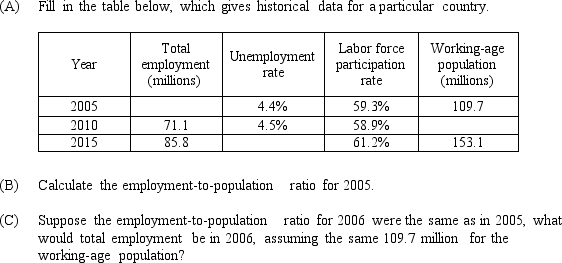
(83) 
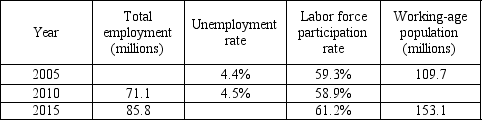
A 21-year-old student looks for a job in the fall, and when she cannot find a suitable job after a few weeks, she gives up her search. This student is
(Multiple Choice)
4.8/5 (86)
(86) The unemployment rates for young adults are higher in France, and Spain than in the United States. Why are these differences in unemployment rates likely to persist?
(Essay)
4.9/5 (85)
(85) The rate of female participation in the labor force has multiplied 10-fold since the 1950s.
(True/False)
4.8/5 (71)
(71) On average, more than half of the unemployed workers stay unemployed for
(Multiple Choice)
4.8/5 (80)
(80) The difference in the unemployment rates among young people in different countries is due to
(Multiple Choice)
4.7/5 (75)
(75) A goal for any market economy is to eradicate very-short-term unemployment.
(True/False)
4.8/5 (89)
(89) Long-term unemployment is not very sensitive to the business cycle.
(True/False)
4.8/5 (81)
(81) The large increase in the percentage of women in the labor force is best described by
(Multiple Choice)
4.9/5 (72)
(72) 
Filters
- Essay(0)
- Multiple Choice(0)
- Short Answer(0)
- True False(0)
- Matching(0)