



 Chat with AI
Exam 20: Unemployment and Employment

Exam 1: The Central Idea156 Questions
Exam 2: Observing and Explaining the Economy143 Questions
Exam 3: The Supply and Demand Model166 Questions
Exam 4: Subtleties of the Supply and Demand Model176 Questions
Exam 5: The Demand Curve and the Behavior of Consumers176 Questions
Exam 6: The Supply Curve and the Behavior of Firms179 Questions
Exam 7: The Efficiency of Markets163 Questions
Exam 8: Costs and the Changes at Firms Over Time191 Questions
Exam 9: The Rise and Fall of Industries139 Questions
Exam 10: Monopoly184 Questions
Exam 11: Product Differentiation, Monopolistic Competition, and Oligopoly169 Questions
Exam 12: Antitrust Policy and Regulation152 Questions
Exam 13: Labor Markets179 Questions
Exam 14: Taxes, Transfers, and Income Distribution179 Questions
Exam 15: Public Goods, Externalities, and Government Behavior197 Questions
Exam 16: Capital and Financial Markets188 Questions
Exam 17: Macroeconomics: the Big Picture159 Questions
Exam 18: Measuring the Production, Income, and Spending of Nations177 Questions
Exam 19: The Spending Allocation Model166 Questions
Exam 20: Unemployment and Employment212 Questions
Exam 21: Productivity and Economic Growth162 Questions
Exam 22: Money and Inflation153 Questions
Exam 23: The Nature and Causes of Economic Fluctuations185 Questions
Exam 24: The Economic Fluctuations Model205 Questions
Exam 25: Using the Economic Fluctuations Model176 Questions
Exam 26: Fiscal Policy138 Questions
Exam 27: Monetary Policy180 Questions
Exam 28: Economic Growth Around the World157 Questions
Exam 29: International Trade242 Questions
Exam 30: International Finance125 Questions
Select questions type


The incidence of unemployment is the same for all demographic groups.
(True/False)
5.0/5  (82)
(82) The unemployment rate among black teenagers is much greater than the overall unemployment rate.
(True/False)
4.9/5 (78)
(78) The growth of aggregate labor hours in the U.S. is slowing down, increasing by less than one percent per year between 2005 and 2015.
(True/False)
4.9/5 (79)
(79) Among the United States, France, and Spain, Spain has both the highest minimum wage (as a fraction of the average wage) and the highest unemployment rate among young adults.
(True/False)
4.9/5 (87)
(87) In the insider-outsider theory of unemployment, those already employed can prevent firms from hiring unemployed workers willing to work at a lower wage.
(True/False)
4.9/5 (72)
(72) The employed labor force is a good measure of the labor input to production.
(True/False)
4.7/5 (80)
(80) For the United States, France, and Spain there is a positive correlation between the percentage of young people living with their parents and the unemployment rate among young people.
(True/False)
4.8/5 (72)
(72) Which of the following might cause the natural unemployment rate to decrease?
(Multiple Choice)
4.9/5 (76)
(76) Cyclical unemployment refers to that kind of unemployment that is related to the short-term cyclical fluctuations of the economy.
(True/False)
4.8/5 (83)
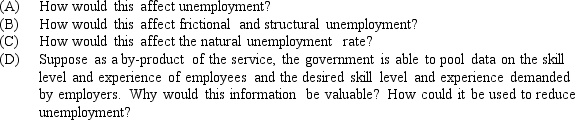
(83) Suppose the government decides to set up a website to link prospective employers and employees. Employers can post jobs and employees can then send resumes.
(Essay)
5.0/5 (92)
(92) The official definition of a part-time worker is any individual working
(Multiple Choice)
5.0/5 (67)
(67) Suppose an individual is working at home without pay. That person would be counted as
(Multiple Choice)
4.9/5 (74)
(74) According to the labor supply schedule, if the price level increases, people will be willing to work more hours because they will need to earn more money to pay for the higher-priced goods.
(True/False)
5.0/5 (70)
(70) Which of the following explanations argues that the labor market is never in a state of rest?
(Multiple Choice)
4.9/5 (71)
(71) An individual who only works 11 months out of a year is classified as a part-time worker.
(True/False)
4.7/5 (86)
(86) 
Filters
- Essay(0)
- Multiple Choice(0)
- Short Answer(0)
- True False(0)
- Matching(0)