



 Chat with AI
Exam 24: The Economic Fluctuations Model

Exam 1: The Central Idea156 Questions
Exam 2: Observing and Explaining the Economy143 Questions
Exam 3: The Supply and Demand Model166 Questions
Exam 4: Subtleties of the Supply and Demand Model176 Questions
Exam 5: The Demand Curve and the Behavior of Consumers176 Questions
Exam 6: The Supply Curve and the Behavior of Firms179 Questions
Exam 7: The Efficiency of Markets163 Questions
Exam 8: Costs and the Changes at Firms Over Time191 Questions
Exam 9: The Rise and Fall of Industries139 Questions
Exam 10: Monopoly184 Questions
Exam 11: Product Differentiation, Monopolistic Competition, and Oligopoly169 Questions
Exam 12: Antitrust Policy and Regulation152 Questions
Exam 13: Labor Markets179 Questions
Exam 14: Taxes, Transfers, and Income Distribution179 Questions
Exam 15: Public Goods, Externalities, and Government Behavior197 Questions
Exam 16: Capital and Financial Markets188 Questions
Exam 17: Macroeconomics: the Big Picture159 Questions
Exam 18: Measuring the Production, Income, and Spending of Nations177 Questions
Exam 19: The Spending Allocation Model166 Questions
Exam 20: Unemployment and Employment212 Questions
Exam 21: Productivity and Economic Growth162 Questions
Exam 22: Money and Inflation153 Questions
Exam 23: The Nature and Causes of Economic Fluctuations185 Questions
Exam 24: The Economic Fluctuations Model205 Questions
Exam 25: Using the Economic Fluctuations Model176 Questions
Exam 26: Fiscal Policy138 Questions
Exam 27: Monetary Policy180 Questions
Exam 28: Economic Growth Around the World157 Questions
Exam 29: International Trade242 Questions
Exam 30: International Finance125 Questions
Select questions type


Exhibit 24-4  -The AD curve shifts to the left as a result of
 (Multiple Choice)
4.8/5  (68)
(68) If a firm expects the rate of inflation to be 2 percent, it will expect its competitors to
(Multiple Choice)
4.7/5 (74)
(74) Which of the following is probably the least sensitive to changes in real interest rates?
(Multiple Choice)
4.8/5 (88)
(88) If the central bank increases the target inflation rate, then
(Multiple Choice)
4.9/5 (80)
(80) Which of the following explains a downward shift in the expenditure line along the vertical axis?
(Multiple Choice)
4.7/5 (84)
(84) Exhibit 24-5 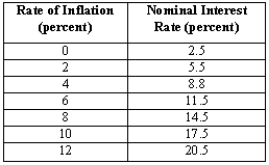 -The data in Exhibit 24-5 depicts the monetary policy response to inflation by a central bank. Use the values in this table to plot the monetary policy response rule line, and explain whether this is a valid response rule or not.
(Essay)
4.9/5 (81)
(81) The market interest rate the Fed focuses on is the federal funds rate.
(True/False)
4.9/5 (89)
(89) The inflation adjustment line is horizontal because firms adjust output before price.
(True/False)
4.7/5 (94)
(94) Suppose, because of a foreign crisis, the foreign exchange value of the dollar increases. Use the analysis developed in the text to show how the AD curve will be affected.
(Essay)
4.9/5 (83)
(83) If government purchases increase, inflation will increase, and there will be an upward movement along the AD curve.
(True/False)
4.7/5 (72)
(72) Which of the following is NOT an element of the economic fluctuations model?
(Multiple Choice)
4.8/5 (86)
(86) A firm expects inflation to remain at 4 percent for the next year. If the firm has been losing sales to competitors, it is most likely to
(Multiple Choice)
4.8/5 (78)
(78) Aggregate expenditures depend on the nominal interest rate because that is the rate that must be paid to the borrower.
(True/False)
4.8/5 (62)
(62) If firms are experiencing slow growth in demand, the inflation adjustment line is likely to shift down.
(True/False)
4.8/5 (83)
(83) 
Filters
- Essay(0)
- Multiple Choice(0)
- Short Answer(0)
- True False(0)
- Matching(0)