



 Chat with AI
Exam 24: The Economic Fluctuations Model

Exam 1: The Central Idea156 Questions
Exam 2: Observing and Explaining the Economy143 Questions
Exam 3: The Supply and Demand Model166 Questions
Exam 4: Subtleties of the Supply and Demand Model176 Questions
Exam 5: The Demand Curve and the Behavior of Consumers176 Questions
Exam 6: The Supply Curve and the Behavior of Firms179 Questions
Exam 7: The Efficiency of Markets163 Questions
Exam 8: Costs and the Changes at Firms Over Time191 Questions
Exam 9: The Rise and Fall of Industries139 Questions
Exam 10: Monopoly184 Questions
Exam 11: Product Differentiation, Monopolistic Competition, and Oligopoly169 Questions
Exam 12: Antitrust Policy and Regulation152 Questions
Exam 13: Labor Markets179 Questions
Exam 14: Taxes, Transfers, and Income Distribution179 Questions
Exam 15: Public Goods, Externalities, and Government Behavior197 Questions
Exam 16: Capital and Financial Markets188 Questions
Exam 17: Macroeconomics: the Big Picture159 Questions
Exam 18: Measuring the Production, Income, and Spending of Nations177 Questions
Exam 19: The Spending Allocation Model166 Questions
Exam 20: Unemployment and Employment212 Questions
Exam 21: Productivity and Economic Growth162 Questions
Exam 22: Money and Inflation153 Questions
Exam 23: The Nature and Causes of Economic Fluctuations185 Questions
Exam 24: The Economic Fluctuations Model205 Questions
Exam 25: Using the Economic Fluctuations Model176 Questions
Exam 26: Fiscal Policy138 Questions
Exam 27: Monetary Policy180 Questions
Exam 28: Economic Growth Around the World157 Questions
Exam 29: International Trade242 Questions
Exam 30: International Finance125 Questions
Select questions type




If real and potential GDP are equal, the rate of inflation will not change.
(True/False)
4.9/5  (73)
(73) When the Fed is worried that the economy is heading into a recession, it
(Multiple Choice)
4.8/5 (79)
(79) Suppose an economy existed in which investment, net exports, and consumption were not sensitive to changes in interest rates. For this economy, the AD curve would
(Multiple Choice)
4.9/5 (78)
(78) Higher real interest rates in the United States compared with other countries increases the demand for U.S. dollar bank accounts and other American interest-bearing assets.
(True/False)
4.8/5 (88)
(88) The inflation adjustment line (IA) shows the level of inflation in an economy. If the IA line intersects the vertical axis at 5 percent, the inflation in the economy is 5 percent at that time.
(True/False)
4.9/5 (88)
(88) Which of the following is an appropriate definition of the target inflation rate?
(Multiple Choice)
4.7/5 (72)
(72) Suppose the central bank decides to switch from policy rule A to policy rule B as shown in the table below. Use the analysis presented in the text to explain what will happen to the AD curve. 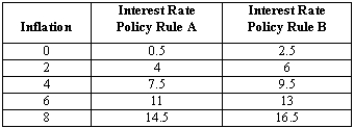
(Essay)
4.8/5 (79)
(79) The flatter the aggregate expenditure line, the less sensitive real GDP is to changes in the interest rate.
(True/False)
4.9/5 (87)
(87) If the nominal interest rate exceeds the rate of inflation, the real interest rate will
(Multiple Choice)
4.9/5 (77)
(77) Explain what will happen to the aggregate demand curve and real GDP in each of the following cases.
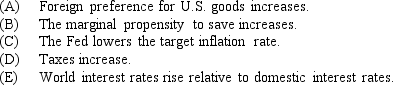
(Essay)
4.8/5 (89)
(89) A firm increases prices only if the demand for its product has increased.
(True/False)
4.7/5 (82)
(82) Assuming constant inflation, a shift of the expenditure line will cause a shift of the AD curve.
(True/False)
4.9/5 (84)
(84) Unlike the demand for bananas in a supermarket, aggregate demand slopes upward.
(True/False)
4.9/5 (76)
(76) The equation for the real interest rate indicates that, other being things equal,
(Multiple Choice)
4.9/5 (102)
(102) 
Filters
- Essay(0)
- Multiple Choice(0)
- Short Answer(0)
- True False(0)
- Matching(0)