



 Chat with AI
Exam 24: The Economic Fluctuations Model

Exam 1: The Central Idea156 Questions
Exam 2: Observing and Explaining the Economy143 Questions
Exam 3: The Supply and Demand Model166 Questions
Exam 4: Subtleties of the Supply and Demand Model176 Questions
Exam 5: The Demand Curve and the Behavior of Consumers176 Questions
Exam 6: The Supply Curve and the Behavior of Firms179 Questions
Exam 7: The Efficiency of Markets163 Questions
Exam 8: Costs and the Changes at Firms Over Time191 Questions
Exam 9: The Rise and Fall of Industries139 Questions
Exam 10: Monopoly184 Questions
Exam 11: Product Differentiation, Monopolistic Competition, and Oligopoly169 Questions
Exam 12: Antitrust Policy and Regulation152 Questions
Exam 13: Labor Markets179 Questions
Exam 14: Taxes, Transfers, and Income Distribution179 Questions
Exam 15: Public Goods, Externalities, and Government Behavior197 Questions
Exam 16: Capital and Financial Markets188 Questions
Exam 17: Macroeconomics: the Big Picture159 Questions
Exam 18: Measuring the Production, Income, and Spending of Nations177 Questions
Exam 19: The Spending Allocation Model166 Questions
Exam 20: Unemployment and Employment212 Questions
Exam 21: Productivity and Economic Growth162 Questions
Exam 22: Money and Inflation153 Questions
Exam 23: The Nature and Causes of Economic Fluctuations185 Questions
Exam 24: The Economic Fluctuations Model205 Questions
Exam 25: Using the Economic Fluctuations Model176 Questions
Exam 26: Fiscal Policy138 Questions
Exam 27: Monetary Policy180 Questions
Exam 28: Economic Growth Around the World157 Questions
Exam 29: International Trade242 Questions
Exam 30: International Finance125 Questions
Select questions type


The aggregate demand curve shows the level of spending for each price level in the economy.
(True/False)
4.8/5  (79)
(79) When real GDP is above potential GDP, the inflation adjustment line IA shifts up.
(True/False)
4.8/5 (87)
(87) What does it mean to claim that the Fed has a policy rule pertaining to inflation?
(Essay)
4.9/5 (79)
(79) When inflation rises, the Fed typically raises interest rates to reduce spending.
(True/False)
4.9/5 (87)
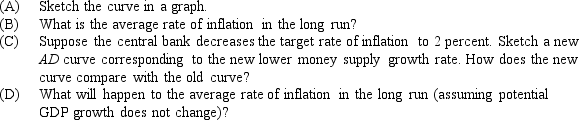
(87) The following table gives a numerical example of an aggregate demand/inflation curve. 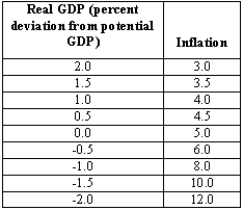
(Essay)
4.8/5 (83)
(83) The best way to approach the debate in Congress over the 2009 stimulus bill is
(Multiple Choice)
5.0/5 (78)
(78) Suppose the Fed is considering three different policy rules, as shown in the following table. 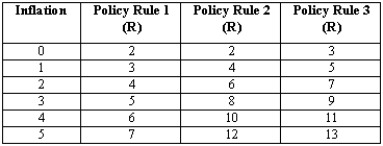

(Essay)
4.9/5 (78)
(78) According to the spending allocation model, what would cause the real interest rate to increase? According to the monetary policy rule, what causes the real interest rate to increase? Are the two models compatible?
(Essay)
4.8/5 (72)
(72) The Fed considers what is happening to the inflation rate only when deciding whether to change the target federal funds rate.
(True/False)
4.9/5 (78)
(78) 
Filters
- Essay(0)
- Multiple Choice(0)
- Short Answer(0)
- True False(0)
- Matching(0)