



 Chat with AI
Exam 5: Forecasting

Exam 1: Introduction to Quantitative Analysis96 Questions
Exam 2: Probability Concepts and Applications155 Questions
Exam 3: Decision Analysis128 Questions
Exam 4: Regression Models129 Questions
Exam 5: Forecasting138 Questions
Exam 6: Inventory Control Models147 Questions
Exam 7: Linear Programming Models: Graphical and Computer Methods141 Questions
Exam 8: Linear Programming Applications89 Questions
Exam 9: Transportation, Assignment, and Network Models112 Questions
Exam 10: Integer Programming, Goal Programming, and Nonlinear Programming86 Questions
Exam 11: Project Management142 Questions
Exam 12: Waiting Lines and Queuing Theory Models127 Questions
Exam 13: Simulation Modeling94 Questions
Exam 14: Markov Analysis103 Questions
Exam 15: Statistical Quality Control96 Questions
Exam 16: Analytic Hierarchy Process66 Questions
Exam 17: Dynamic Programming86 Questions
Exam 18: Decision Theory and the Normal Distribution62 Questions
Exam 19: Game Theory59 Questions
Exam 20: Mathematical Tools: Determinants and Matrices104 Questions
Exam 21: Calculus-Based Optimization39 Questions
Exam 22: Linear Programming: The Simplex Method98 Questions
Exam 23: Transportation, Assignment, and Network Algorithms120 Questions
Select questions type


The three categories of forecasting models are time series, quantitative, and qualitative.
(True/False)
5.0/5  (95)
(95) Consider the actual and forecast values contained in the table. 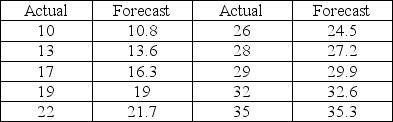 What is the tracking signal for the 5th point in the series (actual = 22 & forecast = 21.7)?
 (Multiple Choice)
4.7/5 (88)
(88) Which of the following is not considered one of the steps to developing the decomposition method?
(Multiple Choice)
4.9/5 (78)
(78) Consider the actual and forecast values contained in the table. 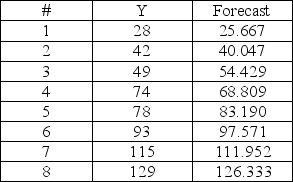 At which observation is the tracking signal at its maximum value?
 (Multiple Choice)
4.9/5 (74)
(74) In the exponential smoothing with trend adjustment forecasting method, β is the
(Multiple Choice)
4.8/5 (82)
(82) Which of the following is considered a causal method of forecasting?
(Multiple Choice)
4.9/5 (80)
(80) What is the basic additive decomposition model (in regression terms)?
(Essay)
4.8/5 (93)
(93) Sales for boxes of Girl Scout cookies over a 4-month period were forecasted as follows: 100, 120, 115, and 123.The actual results over the 4-month period were as follows: 110, 114, 119, 115.What was the MSE of the 4-month forecast?
(Multiple Choice)
4.9/5 (81)
(81) Demand for Y is shown in the table. 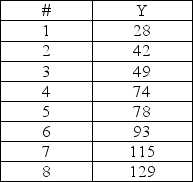 What is the slope of the appropriate trend equation?
 (Multiple Choice)
4.9/5 (79)
(79) In general terms, describe what TIME SERIES forecasting models are.
(Short Answer)
4.9/5 (83)
(83) Daily humidity in the city of Houston for the last week have been: 93, 94, 93, 95, 92, 86, 98 (yesterday).Forecast the humidity today using a three-day moving average.
(Multiple Choice)
4.8/5 (65)
(65) The following table shows the number of pies consumed by the deans' suite during a monthly pie-eating contest. 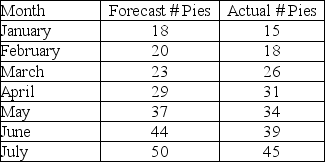 What is the forecast bias?
 (Multiple Choice)
4.9/5 (83)
(83) Demand for Y is shown in the table. 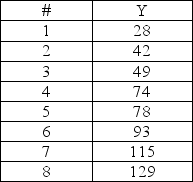 What is the intercept of the appropriate trend equation?
 (Multiple Choice)
4.9/5 (69)
(69) Enrollment in a particular class for the last four semesters has been 122, 128, 100, and 155 (listed from oldest to most recent).The best forecast of enrollment next semester, based on a three-semester moving average, would be
(Multiple Choice)
4.8/5 (88)
(88) The exponential smoothing with trend model uses two smoothing constants, one constant works as in the exponential smoothing model and the other adjusts the line for presence of a trend.
(True/False)
4.7/5 (72)
(72) Multiple regression may be used to forecast both trend and seasonal components present in a time series.
(True/False)
4.8/5 (70)
(70) Demand for a particular type of battery fluctuates from one week to the next.A study of the last six weeks provides the following demands (in dozens): 4, 5, 3, 2, 8, 10 (last week).
(a)Forecast demand for the next week using a two-week moving average.
(b)Forecast demand for the next week using a three-week moving average.
(Essay)
4.8/5 (75)
(75) For the data below:
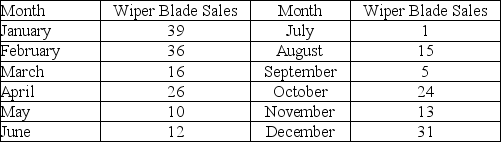 (a)Develop a scatter diagram.
(b)Develop a three-month moving average.
(c)Compute MAD.
(a)Develop a scatter diagram.
(b)Develop a three-month moving average.
(c)Compute MAD. (Essay)
4.9/5 (85)
(85) 
Filters
- Essay(0)
- Multiple Choice(0)
- Short Answer(0)
- True False(0)
- Matching(0)