



 Chat with AI
Exam 1: Introduction

Exam 1: Introduction81 Questions
Exam 2: The Chemistry and Energy of Life87 Questions
Exam 3: Nucleic Acids, Proteins, and Enzymes118 Questions
Exam 4: Cells: the Working Units of Life115 Questions
Exam 5: Cell Membranes and Signaling95 Questions
Exam 6: Pathways That Harvest and Store Chemical Energy130 Questions
Exam 7: The Cell Cycle and Cell Division119 Questions
Exam 8: Inheritance, Genes, and Chromosomes80 Questions
Exam 9: DNA and Its Role in Heredity94 Questions
Exam 10: From Dna to Protein: Gene Expression80 Questions
Exam 11: Regulation of Gene Expression94 Questions
Exam 12: Genomes78 Questions
Exam 13: Biotechnology83 Questions
Exam 14: Genes, Development, and Evolution94 Questions
Exam 15: Processes of Evolution83 Questions
Exam 16: Reconstructing and Using Phylogenies76 Questions
Exam 17: Speciation80 Questions
Exam 18: The History of Life on Earth82 Questions
Exam 19: Bacteria, Archaea, and Viruses100 Questions
Exam 20: The Origin and Diversification of Eukaryotes96 Questions
Exam 21: The Evolution of Plants130 Questions
Exam 22: The Evolution and Diversity of Fungi103 Questions
Exam 23: Animal Origins and Diversity136 Questions
Exam 24: The Plant Body90 Questions
Exam 25: Plant Nutrition and Transport129 Questions
Exam 26: Plant Growth and Development85 Questions
Exam 27: Reproduction of Flowering Plants85 Questions
Exam 28: Plants in the Environment85 Questions
Exam 29: Fundamentals of Animal Function86 Questions
Exam 30: Nutrition and Digestion81 Questions
Exam 31: Breathing83 Questions
Exam 32: Circulation80 Questions
Exam 33: Muscle and Movement75 Questions
Exam 34: Neurons, Sense Organs, and Nervous Systems171 Questions
Exam 35: Nervous and Endocrine Control94 Questions
Exam 36: Water and Salts: Excretion85 Questions
Exam 37: Animal Reproduction84 Questions
Exam 38: Animal Development104 Questions
Exam 39: Immunology: Animal Defense Systems91 Questions
Exam 40: Animal Behavior83 Questions
Exam 41: The Distribution of Earths Ecological Systems82 Questions
Exam 42: Populations78 Questions
Exam 43: Ecological and Evolutionary Consequences of Interactions Within and Among Species114 Questions
Exam 44: Ecological Communities121 Questions
Exam 45: The Global Ecosystem127 Questions
Select questions type


Which statement about statistical analysis in science is true?
(Multiple Choice)
4.8/5  (84)
(84) If you were trying to create rapid evolutionary change in a population of bacteria,what treatment would be most effective?
(Multiple Choice)
4.8/5 (91)
(91) Which trait or function is the same in muscle cells and brain cells?
(Multiple Choice)
4.9/5 (84)
(84) Frogs eat insects,insects ingest the tissue of plant leaves,and plants derive their energy from the sun through photosynthesis.Assuming that energy conversions are not 100 percent efficient,the total biomass of animals should be _______ than that of plants.
(Essay)
4.7/5 (73)
(73) Which of the following can result from a scientific investigation?
(Multiple Choice)
4.9/5 (87)
(87) Every living organism on Earth can be assigned to one of three separate
(Multiple Choice)
4.9/5 (77)
(77) In looking at prepared slides of organisms from pond water using a microscope,you see a unicellular organism that has genetic material but no nucleus.Which group could this organism possibly belong to?
(Multiple Choice)
4.7/5 (98)
(98) Which structure(s)is/are necessary in the forming of a cell?
(Multiple Choice)
4.9/5 (81)
(81) During childbirth,the hormone oxytocin causes uterine contractions.These contractions move the baby toward the birth canal (vagina),where it pushes on pressure-sensing receptors.These receptors signal the mother's hypothalamus to produce more oxytocin,which in turn increases the uterine contractions.This is an example of
(Multiple Choice)
4.9/5 (76)
(76) If you were able to travel back in time 4 billion years to when life first appeared on Earth,what feature of Earth would make it immediately impossible for you to survive?
(Multiple Choice)
4.8/5 (74)
(74) Suppose you were leading a team looking for extraterrestrial life on distant planets.You find something that you suspect might be a living organism.Which characteristic would be a requirement in order for it to be classified as a living organism?
(Multiple Choice)
4.9/5 (95)
(95) Darwin noted that all populations have _______ potential to grow,but in nature most populations _______ over time.
(Multiple Choice)
4.9/5 (91)
(91) If a mutation arises spontaneously in one of your blood cells,
(Multiple Choice)
4.9/5 (73)
(73) Use the following to answer questions :
Refer to the figure below showing a tree of life. 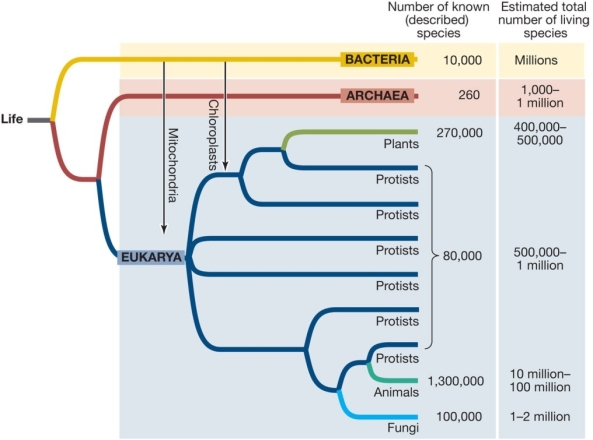 -What is one conclusion that you can draw from the figure?
 (Multiple Choice)
5.0/5 (71)
(71) A rapid decline of amphibian populations has been observed worldwide.Which of the following could not be a reasonable hypothesis to explain this decline?
(Multiple Choice)
4.8/5 (83)
(83) A scientist walking by a pristine stream,and then a polluted pond below a mill,observes that fish are present in the stream but not in the pond.The scientist then says,"polluted water kills fish." This statement is an example of
(Multiple Choice)
4.8/5 (67)
(67) What is one major reason that the earliest organisms on Earth were confined to the oceans?
(Multiple Choice)
4.9/5 (85)
(85) 
Filters
- Essay(0)
- Multiple Choice(0)
- Short Answer(0)
- True False(0)
- Matching(0)