



 Chat with AI
Exam 1: Introduction

Exam 1: Introduction81 Questions
Exam 2: The Chemistry and Energy of Life87 Questions
Exam 3: Nucleic Acids, Proteins, and Enzymes118 Questions
Exam 4: Cells: the Working Units of Life115 Questions
Exam 5: Cell Membranes and Signaling95 Questions
Exam 6: Pathways That Harvest and Store Chemical Energy130 Questions
Exam 7: The Cell Cycle and Cell Division119 Questions
Exam 8: Inheritance, Genes, and Chromosomes80 Questions
Exam 9: DNA and Its Role in Heredity94 Questions
Exam 10: From Dna to Protein: Gene Expression80 Questions
Exam 11: Regulation of Gene Expression94 Questions
Exam 12: Genomes78 Questions
Exam 13: Biotechnology83 Questions
Exam 14: Genes, Development, and Evolution94 Questions
Exam 15: Processes of Evolution83 Questions
Exam 16: Reconstructing and Using Phylogenies76 Questions
Exam 17: Speciation80 Questions
Exam 18: The History of Life on Earth82 Questions
Exam 19: Bacteria, Archaea, and Viruses100 Questions
Exam 20: The Origin and Diversification of Eukaryotes96 Questions
Exam 21: The Evolution of Plants130 Questions
Exam 22: The Evolution and Diversity of Fungi103 Questions
Exam 23: Animal Origins and Diversity136 Questions
Exam 24: The Plant Body90 Questions
Exam 25: Plant Nutrition and Transport129 Questions
Exam 26: Plant Growth and Development85 Questions
Exam 27: Reproduction of Flowering Plants85 Questions
Exam 28: Plants in the Environment85 Questions
Exam 29: Fundamentals of Animal Function86 Questions
Exam 30: Nutrition and Digestion81 Questions
Exam 31: Breathing83 Questions
Exam 32: Circulation80 Questions
Exam 33: Muscle and Movement75 Questions
Exam 34: Neurons, Sense Organs, and Nervous Systems171 Questions
Exam 35: Nervous and Endocrine Control94 Questions
Exam 36: Water and Salts: Excretion85 Questions
Exam 37: Animal Reproduction84 Questions
Exam 38: Animal Development104 Questions
Exam 39: Immunology: Animal Defense Systems91 Questions
Exam 40: Animal Behavior83 Questions
Exam 41: The Distribution of Earths Ecological Systems82 Questions
Exam 42: Populations78 Questions
Exam 43: Ecological and Evolutionary Consequences of Interactions Within and Among Species114 Questions
Exam 44: Ecological Communities121 Questions
Exam 45: The Global Ecosystem127 Questions
Select questions type


In formulating his theory of evolution,Darwin used information available to him through observation and common knowledge,including the knowledge that
(Multiple Choice)
4.9/5  (80)
(80) Your body constitutes a system of organized units controlling your internal environment,such as the concentration of Na+ in your blood.If this concentration falls below normal,you would have hyponatremia,a condition that can cause headaches,mental confusion,and even seizures.Which event would most likely cause hyponatremia?
(Multiple Choice)
4.9/5 (80)
(80) Use the following to answer questions :
Refer to the figure below showing a tree of life. 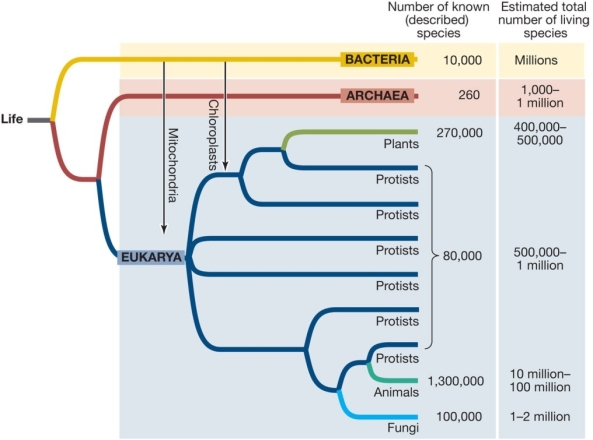 -Which statement concerning the figure is true?
 (Multiple Choice)
4.8/5 (82)
(82) Which list represents a correct ordering of the levels of complexity at which life is studied,from most simple to most complex?
(Multiple Choice)
4.9/5 (79)
(79) One reason we consider the dormant seed of a desert plant to be alive is that it
(Multiple Choice)
4.9/5 (94)
(94) What is the correct order in which the following appeared during the early evolution of life on Earth?
(Multiple Choice)
4.7/5 (68)
(68) If we picture the history of Earth as a 30-day month,modern humans arose
(Multiple Choice)
4.9/5 (89)
(89) Biologists have organized the diversity of life into three domains based largely on
(Multiple Choice)
4.9/5 (64)
(64) Many possible applications of scientific knowledge raise ethical issues for some people.Which application,however,would be rejected by all responsible scientists?
(Multiple Choice)
4.9/5 (71)
(71) A biologist listens to frogs singing at a local pond and hypothesizes that the sounds are mating calls.What would be the next step in the hypothesis-prediction method?
(Multiple Choice)
5.0/5 (85)
(85) For a multicellular organism to have evolved from a unicellular ancestor,what new feature must have been present that was not necessary for unicellular life-forms?
(Multiple Choice)
4.9/5 (91)
(91) Use the following to answer questions :
Refer to the figure below.  -In the image above,what is the largest (highest)level of biological organization that is visible?
 (Multiple Choice)
4.9/5 (73)
(73) 
Filters
- Essay(0)
- Multiple Choice(0)
- Short Answer(0)
- True False(0)
- Matching(0)