



 Chat with AI
Exam 42: Populations

Exam 1: Introduction81 Questions
Exam 2: The Chemistry and Energy of Life87 Questions
Exam 3: Nucleic Acids, Proteins, and Enzymes118 Questions
Exam 4: Cells: the Working Units of Life115 Questions
Exam 5: Cell Membranes and Signaling95 Questions
Exam 6: Pathways That Harvest and Store Chemical Energy130 Questions
Exam 7: The Cell Cycle and Cell Division119 Questions
Exam 8: Inheritance, Genes, and Chromosomes80 Questions
Exam 9: DNA and Its Role in Heredity94 Questions
Exam 10: From Dna to Protein: Gene Expression80 Questions
Exam 11: Regulation of Gene Expression94 Questions
Exam 12: Genomes78 Questions
Exam 13: Biotechnology83 Questions
Exam 14: Genes, Development, and Evolution94 Questions
Exam 15: Processes of Evolution83 Questions
Exam 16: Reconstructing and Using Phylogenies76 Questions
Exam 17: Speciation80 Questions
Exam 18: The History of Life on Earth82 Questions
Exam 19: Bacteria, Archaea, and Viruses100 Questions
Exam 20: The Origin and Diversification of Eukaryotes96 Questions
Exam 21: The Evolution of Plants130 Questions
Exam 22: The Evolution and Diversity of Fungi103 Questions
Exam 23: Animal Origins and Diversity136 Questions
Exam 24: The Plant Body90 Questions
Exam 25: Plant Nutrition and Transport129 Questions
Exam 26: Plant Growth and Development85 Questions
Exam 27: Reproduction of Flowering Plants85 Questions
Exam 28: Plants in the Environment85 Questions
Exam 29: Fundamentals of Animal Function86 Questions
Exam 30: Nutrition and Digestion81 Questions
Exam 31: Breathing83 Questions
Exam 32: Circulation80 Questions
Exam 33: Muscle and Movement75 Questions
Exam 34: Neurons, Sense Organs, and Nervous Systems171 Questions
Exam 35: Nervous and Endocrine Control94 Questions
Exam 36: Water and Salts: Excretion85 Questions
Exam 37: Animal Reproduction84 Questions
Exam 38: Animal Development104 Questions
Exam 39: Immunology: Animal Defense Systems91 Questions
Exam 40: Animal Behavior83 Questions
Exam 41: The Distribution of Earths Ecological Systems82 Questions
Exam 42: Populations78 Questions
Exam 43: Ecological and Evolutionary Consequences of Interactions Within and Among Species114 Questions
Exam 44: Ecological Communities121 Questions
Exam 45: The Global Ecosystem127 Questions
Select questions type


An increase in rainfall brings more plant resources to a population of lizards,but it also brings more predators.These changes result in both an increase in fecundity and a decrease in survivorship.Under these conditions,which event is most likely?
(Multiple Choice)
4.9/5  (77)
(77) Which statement about the rockfish Sebastes melanops is false?
(Multiple Choice)
4.8/5 (70)
(70) Which statement about subpopulations within metapopulations is false?
(Multiple Choice)
5.0/5 (69)
(69) Suppose the population density of a sample of a bagworm population is 45 per square meter.Assuming that the population is uniformly distributed,what would be the population size if the bagworms encompassed an area that was 1 km × 200 m?
(Multiple Choice)
4.8/5 (78)
(78) Which observation best supports the argument that that human population of the Earth is still below its long-term carrying capacity?
(Multiple Choice)
4.8/5 (74)
(74) The doubling time of a population of annual plants is 14 years.Assuming that the initial size of the population is 500 and that the rate of increase remains constant,how large will the population be after 42 years?
(Multiple Choice)
4.9/5 (87)
(87) Eighty-one pocket gophers were present in Maddox Field at the start of 2006.During that year,24 individuals were born and 19 died.Twelve individuals immigrated and 10 emigrated.How many pocket gophers were present in Maddox Field at the start of 2007?
(Multiple Choice)
4.8/5 (91)
(91) If a certain age interval in a population contains ten individuals and has a mortality rate of 1.00,how many individuals will be in the next older age interval?
(Multiple Choice)
5.0/5 (85)
(85) Which is a major assumption of the BD model of population change?
(Multiple Choice)
4.8/5 (72)
(72) The relationship between the rate at which kangaroo rats can harvest seeds and the seed density best illustrates
(Multiple Choice)
5.0/5 (66)
(66) Use the following to answer questions :
Refer to the figure below. 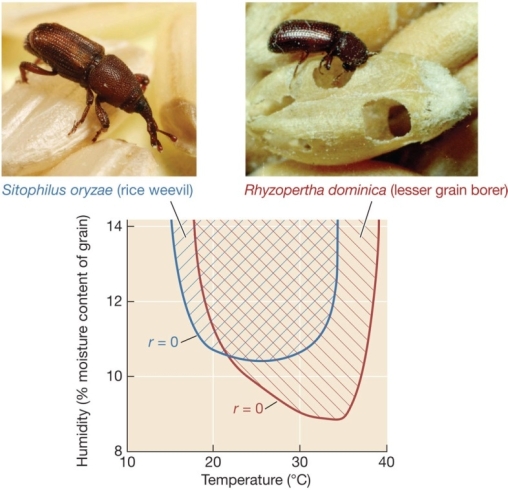 -Under which conditions can both the rice weevil and the lesser grain borer persist indefinitely?
 (Multiple Choice)
5.0/5 (82)
(82) If the survivorship of a sample of geese is 0.75 for the month of March,what is the fecundity of this sample?
(Multiple Choice)
4.8/5 (72)
(72) At the beginning of May,259 butterflies are found in a certain locality.During the month,45 butterflies emigrate,10 die,and 67 immigrate into the area.There are no butterfly births.What is the population size at the end of the month?
(Multiple Choice)
4.8/5 (74)
(74) If a total of 2,400 oak trees are counted in a 6 km × 2 km rectangular patch of land,the density of the oak trees is _______ per square km.
(Multiple Choice)
4.9/5 (83)
(83) Which factor would be most conducive to counting all of the individuals in a population instead of taking a sample?
(Multiple Choice)
4.7/5 (75)
(75) In resource allocation,the needs of _______ generally must be taken care of before resources can be devoted to other activities.
(Multiple Choice)
4.9/5 (83)
(83) The number of individuals in a population divided by the area that the population takes up is known as the _______ of the population.
(Multiple Choice)
4.9/5 (86)
(86) What is the fundamental distinction between resources and physical conditions?
(Multiple Choice)
4.9/5 (80)
(80) 
Filters
- Essay(0)
- Multiple Choice(0)
- Short Answer(0)
- True False(0)
- Matching(0)