



 Chat with AI
Exam 34: Ray Optics

Exam 1: Concepts of Motion52 Questions
Exam 2: Kinematics in One Dimension59 Questions
Exam 3: Vectors and Coordinate Systems33 Questions
Exam 4: Kinematics in Two Dimensions49 Questions
Exam 5: Force and Motion30 Questions
Exam 6: Dynamics I: Motion Along a Line46 Questions
Exam 7: Newtons Third Law43 Questions
Exam 8: Dynamics II: Motion in a Plane20 Questions
Exam 9: Work and Kinetic Energy66 Questions
Exam 10: Interactions and Potential Energy55 Questions
Exam 11: Impulse and Momentum43 Questions
Exam 12: Rotation of a Rigid Body116 Questions
Exam 13: Newtons Theory of Gravity50 Questions
Exam 14: Fluids and Elasticity72 Questions
Exam 15: Oscillations49 Questions
Exam 16: Traveling Waves51 Questions
Exam 17: Superposition51 Questions
Exam 18: A Macroscopic Description of Matter46 Questions
Exam 19: Work, heat, and the First Law of Thermodynamics96 Questions
Exam 20: The Micromacro Connection41 Questions
Exam 21: Heat Engines and Refrigerators44 Questions
Exam 22: Electric Charges and Forces26 Questions
Exam 23: The Electric Field32 Questions
Exam 24: Gausss Law41 Questions
Exam 25: The Electric Potential40 Questions
Exam 26: Potential and Field57 Questions
Exam 27: Current and Resistance32 Questions
Exam 28: Fundamentals of Circuits68 Questions
Exam 29: The Magnetic Field83 Questions
Exam 30: Electromagnetic Induction66 Questions
Exam 31: Electromagnetic Fields and Waves52 Questions
Exam 32: Ac Circuits44 Questions
Exam 33: Wave Optics51 Questions
Exam 34: Ray Optics60 Questions
Exam 35: Optical Instruments52 Questions
Exam 36: Relativity49 Questions
Exam 37: The Foundations of Modern Physics7 Questions
Exam 38: Quantization45 Questions
Exam 39: Wave Functions and Uncertainty18 Questions
Exam 40: One-Dimensional Quantum Mechanics32 Questions
Exam 41: Atomic Physics38 Questions
Exam 42: Nuclear Physics64 Questions
Select questions type


A convex lens has focal length f.If an object is located extremely far from the lens (at infinity),the image formed is located what distance from the lens?
(Multiple Choice)
4.8/5  (80)
(80) The left-hand end of a glass rod is ground to a spherical surface.The glass has index of refraction 1.50.A small object 4.00 mm tall is placed on the axis of the rod,37.0 cm to the left of the vertex of the spherical surface.The image is formed in the rod,50.0 cm to the right of the vertex.
(a)What is the magnitude of the radius of curvature of the spherical surface at the end of the rod?
(b)What is the height of the image?
(Short Answer)
4.9/5 (87)
(87) A concave spherical mirror with a radius of 20 cm creates a real image 30 cm from the mirror.How far is the object from the mirror?
(Multiple Choice)
4.8/5 (85)
(85) An oil layer that is 5.0 cm thick is spread smoothly and evenly over the surface of water on a windless day.What is the angle of refraction in the water for a ray of light that has an angle of incidence of 45° as it enters the oil from the air above? (The index of refraction for the oil is 1.15,and for water it is 1.33.)
(Multiple Choice)
4.8/5 (84)
(84) A tank holds a 1.44-m thick layer of oil that floats on a 0.96-m thick layer of brine.Both liquids are clear and do not intermix.Point O is at the bottom of the tank,on a vertical axis.The indices of refraction of the oil and the brine are 1.40 and 1.52,respectively.A ray originating at O reaches the brine-oil interface at the critical angle.What is the distance of this point from the axis?
(Multiple Choice)
4.9/5 (67)
(67) Suppose you place your face in front of a concave mirror.Which one of the following statements is correct?
(Multiple Choice)
4.9/5 (86)
(86) It is desired to project the image of an object four times its actual size using a lens of focal length 20 cm.How far from the lens should the object be placed?
(Multiple Choice)
4.7/5 (86)
(86) A ray of light passes from glass into a liquid,as shown in the figure.What is the speed of the light in the liquid? (c = 3.00 × 10⁸ m/s) 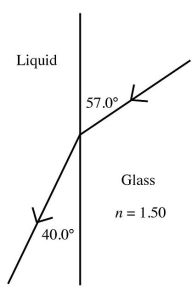
(Short Answer)
4.8/5 (83)
(83) In the figure,the thin lens forms a real image of the object 94.0 cm from the object.What is the focal length of the lens? 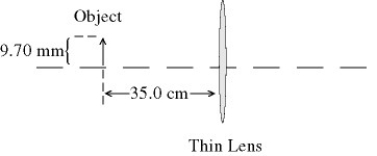
(Multiple Choice)
4.8/5 (72)
(72) A convex spherical mirror with a focal length of magnitude 25 cm has a 4.0-cm tall flower placed 100 cm in front of it.What is the height of the image of the flower?
(Multiple Choice)
4.9/5 (61)
(61) Light in air is initially traveling parallel to the face AC of an equilateral triangular prism,as shown in the figure.The prism is made of glass with an index of refraction of 1.52.If the light does not strike the face AC,what is the angle between the ray as it leaves the prism at face BC and the normal in air at that face? 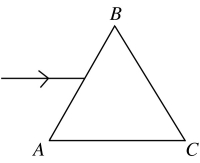
(Multiple Choice)
4.8/5 (78)
(78) A compound lens is made by joining the plane surfaces of two thin plano-convex lenses of different glasses.The radius of curvature of each convex surface is 80 cm.The indices of refraction of the two glasses are 1.50 and 1.60.What is the focal length of the compound lens?
(Multiple Choice)
4.8/5 (82)
(82) A ray of light strikes a boundary between two transparent materials,and there is no transmitted ray,as shown in the figure.What can you conclude about the indices of refraction of these two materials? 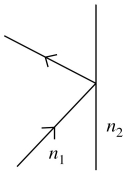
(Multiple Choice)
4.8/5 (86)
(86) A glass plate whose index of refraction is 1.56 is immersed in a liquid.The surface of the glass is inclined at an angle of 42.0° with the vertical.A horizontal ray in the glass is incident on the interface.When the liquid is a certain alcohol,the incident ray arrives at the interface at the critical angle.What is the index of refraction of the alcohol?
(Multiple Choice)
4.8/5 (75)
(75) A lens is made with a focal length of -40 cm using a material with index of refraction 1.50.A second lens is made with the SAME GEOMETRY as the first lens,but using a material having refractive index of 2.00.What is the focal length of the second lens?
(Multiple Choice)
4.9/5 (78)
(78) An object 1.25 cm tall is placed 100 cm in front of a convex lens with a focal length of magnitude 50 cm.A concave lens with a focal length of magnitude 20 cm is placed 90 cm beyond the first lens.Where is the final image located?
(Multiple Choice)
4.7/5 (70)
(70) As you walk away from a vertical plane mirror,your image in the mirror
(Multiple Choice)
4.9/5 (85)
(85) An optical system comprises in turn,from left to right: an observer,a lens of focal length +30 cm,an erect object 20 mm high,and a convex mirror of radius 80 cm.The object is between the lens and the mirror,20 cm from the lens and 50 cm from the mirror.The observer views the image that is formed first by reflection and then by refraction.What is the position of the final image,measured from the mirror? 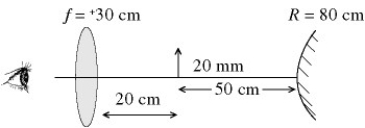
(Multiple Choice)
4.8/5 (77)
(77) Which statements are true about a VIRTUAL image? (There may be more than one correct choice.)
(Multiple Choice)
4.8/5 (70)
(70) A convex spherical mirror with a radius of 50 cm has a 4.0 cm tall object placed 100 cm in front of it.What is the position of the image relative to the mirror?
(Multiple Choice)
4.8/5 (63)
(63) 
Filters
- Essay(0)
- Multiple Choice(0)
- Short Answer(0)
- True False(0)
- Matching(0)