



 Chat with AI
Exam 19: Economic Inequality

Exam 1: What Is Economics479 Questions
Exam 2: The Economic Problem439 Questions
Exam 3: Demand and Supply515 Questions
Exam 4: Elasticity533 Questions
Exam 5: Efficiency and Equity449 Questions
Exam 6: Government Actions in Markets410 Questions
Exam 7: Global Markets in Action200 Questions
Exam 8: Utility and Demand364 Questions
Exam 9: Possibilities, Preferences, and Choices464 Questions
Exam 10: Organizing Production385 Questions
Exam 11: Output and Costs494 Questions
Exam 12: Perfect Competition487 Questions
Exam 13: Monopoly606 Questions
Exam 14: Monopolistic Competition320 Questions
Exam 15: Oligopoly280 Questions
Exam 16: Public Choices and Public Goods356 Questions
Exam 17: Externalities and the Environment284 Questions
Exam 18: Markets for Factors of Production382 Questions
Exam 19: Economic Inequality354 Questions
Exam 20: Uncertainty and Information233 Questions
Exam 21: Extension A: Review11 Questions
Exam 22: Extension B: Review25 Questions
Exam 23: Extension C: Review14 Questions
Exam 24: Extension D: Review38 Questions
Exam 25: Extension E: Review11 Questions
Exam 26: Extension F: Review18 Questions
Select questions type


Market income is defined as wages, interest, rent, and profit earned in factor markets plus cash payments to households by the government.
(True/False)
4.7/5  (73)
(73) An income tax in which the average tax rate increases with income is called a
(Multiple Choice)
4.9/5 (74)
(74)  -The figure above shows two Lorenz curves, one before income redistribution and one after income redistribution. Lorenz curve B represents
 (Multiple Choice)
4.8/5 (86)
(86) The 2010 Federal Personal Income six tax brackets range from 10 percent for individuals earning less than $8,025 to 35 percent for those earning over $357,700. The personal income tax system is
(Multiple Choice)
4.8/5 (84)
(84)  -The Lorenz curve in the above figure implies that
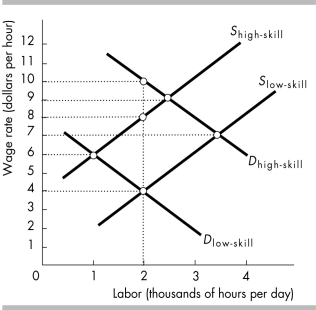 -The above figure shows the demand and supply curves for high-skilled and low-skilled labor. The wage differential between high-skilled and low-skilled labor is
 (Multiple Choice)
4.9/5 (78)
(78) An income tax system in which the average tax rate decreases with the level of income is called a
(Multiple Choice)
5.0/5 (65)
(65) Some economists argue that discrimination based on race and sex cannot lead to persistent wage differentials. What is their argument?
(Essay)
4.9/5 (68)
(68) The table shows the distributions of market income and money income in the United States in 2007.  -According to the table above, ________ percent of total income is redistributed to the lowest income group.
 (Multiple Choice)
4.8/5 (86)
(86) A government redistribution of income program is proposed with the aim of making the income distribution the same as the 45° line in a Lorenz curve diagram. What implications does the idea of the "big tradeoff" have for the program?
(Essay)
4.9/5 (77)
(77) Making the distribution of wealth ________ equal is ________.
(Multiple Choice)
4.9/5 (79)
(79) Lee earns more than does Pat. Which of the following can explain why?
(Multiple Choice)
4.9/5 (78)
(78)  -In the above table, which tax plan is regressive?
 -In the figure above, the poorest 40 percent of all households receive what share of income?
 (Multiple Choice)
4.7/5 (67)
(67) The "big tradeoff" refers to the point that governmental redistribution of income causes
(Multiple Choice)
4.9/5 (79)
(79) 
Filters
- Essay(0)
- Multiple Choice(0)
- Short Answer(0)
- True False(0)
- Matching(0)