



 Chat with AI
Exam 19: Economic Inequality

Exam 1: What Is Economics479 Questions
Exam 2: The Economic Problem439 Questions
Exam 3: Demand and Supply515 Questions
Exam 4: Elasticity533 Questions
Exam 5: Efficiency and Equity449 Questions
Exam 6: Government Actions in Markets410 Questions
Exam 7: Global Markets in Action200 Questions
Exam 8: Utility and Demand364 Questions
Exam 9: Possibilities, Preferences, and Choices464 Questions
Exam 10: Organizing Production385 Questions
Exam 11: Output and Costs494 Questions
Exam 12: Perfect Competition487 Questions
Exam 13: Monopoly606 Questions
Exam 14: Monopolistic Competition320 Questions
Exam 15: Oligopoly280 Questions
Exam 16: Public Choices and Public Goods356 Questions
Exam 17: Externalities and the Environment284 Questions
Exam 18: Markets for Factors of Production382 Questions
Exam 19: Economic Inequality354 Questions
Exam 20: Uncertainty and Information233 Questions
Exam 21: Extension A: Review11 Questions
Exam 22: Extension B: Review25 Questions
Exam 23: Extension C: Review14 Questions
Exam 24: Extension D: Review38 Questions
Exam 25: Extension E: Review11 Questions
Exam 26: Extension F: Review18 Questions
Select questions type


 -In the figure above, the curve going through point A represents
 (Multiple Choice)
4.7/5  (78)
(78) An increase in income equality causes the Lorenz curve to become more bowed away from the line of equality.
(True/False)
4.8/5 (79)
(79) What is "human capital"? How is it important in the determination of a worker's wage rate?
(Essay)
4.7/5 (73)
(73) Information technologies are a ________ for low-skilled labor and a ________ for high-skilled labor.
(Multiple Choice)
4.8/5 (69)
(69) A firm that discriminates has ________ a nonprejudiced firm and ________.
(Multiple Choice)
4.8/5 (83)
(83) In the country of Konswano there are 4 people. Each person lives for 40 years. In their first 10 years, they earn no income. In the next 20 years, they earn $40,000 per year and in the last 10 years they earn no income. Each year their consumption is $20,000. If the people in Konswano are aged 5, 15, 25, and 35, then the distribution of annual income ________.
(Multiple Choice)
4.8/5 (91)
(91)  -In the figure above, the richest 20 percent of households receive ________ of total income.
 (Multiple Choice)
4.8/5 (76)
(76) What do the Lorenz curves for wealth and income in the United States look like? Which is closer to the line of equality?
(Essay)
4.7/5 (76)
(76)
-In the figure above, if income were distributed equally across all households, the richest 20 percent of households would receive ________ of total income.
-In the figure above, if income were distributed equally across all households, the richest 20 percent of households would receive ________ of total income. (Multiple Choice)
4.8/5 (77)
(77)  -The above figure shows the Lorenz curve for wealth for the nation of Rusha. What percent of wealth is owned by the poorest quintile?
 (Multiple Choice)
5.0/5 (76)
(76) 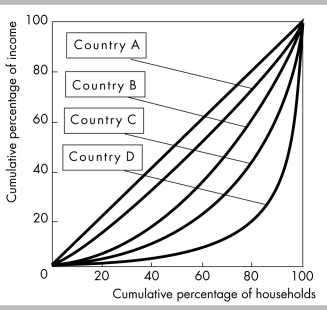 -The above figure shows the Lorenz curves for four different countries. Which country has the most unequal distribution of income?
 (Multiple Choice)
4.9/5 (72)
(72) Globalization means that firms recruit top talent from the global talent pool. Globalization means that the payoffs won by the contest winners ________.
(Multiple Choice)
4.8/5 (81)
(81) Income is distributed ________ equally than wealth and the Lorenz curve for ________ lies closer to the line of equality.
(Multiple Choice)
4.8/5 (76)
(76) 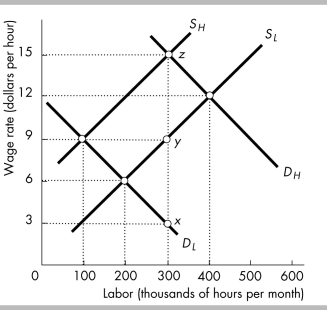 -The above figure shows the supply and demand curves for high-skilled and low-skilled labor. The figure shows that high-skilled workers earn a wage rate greater than low-skilled workers because
 (Multiple Choice)
4.7/5 (69)
(69) 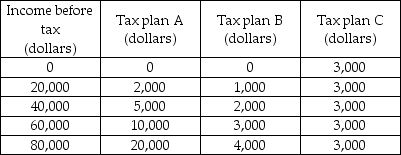 -The government in the country of Zappoo is trying to decide which tax plan to implement. The table above shows three alternative plans. If the government decides to implement a progressive income tax, it will implement tax plan ________.
 (Multiple Choice)
4.9/5 (67)
(67) Specialization of productive activity between men and women might explain why
(Multiple Choice)
4.9/5 (90)
(90) The demand curve for high-skilled labor lies to the right of the demand curve for low-skilled labor because
(Multiple Choice)
4.8/5 (84)
(84) 
Filters
- Essay(0)
- Multiple Choice(0)
- Short Answer(0)
- True False(0)
- Matching(0)