



 Chat with AI
Exam 19: Heat Engines and Refrigerators

Exam 1: Concepts of Motion52 Questions
Exam 2: Kinematics in One Dimension59 Questions
Exam 3: Vectors and Coordinate Systems33 Questions
Exam 4: Kinematics in Two Dimensions50 Questions
Exam 5: Force and Motion31 Questions
Exam 6: Dynamics I: Motion Along a Line46 Questions
Exam 7: Newtons Third Law43 Questions
Exam 8: Dynamics Ii: Motion in a Plane20 Questions
Exam 9: Impulse and Momentum20 Questions
Exam 10: Energy43 Questions
Exam 11: Work100 Questions
Exam 12: Rotation of a Rigid Body113 Questions
Exam 13: Newtons Theory of Gravity50 Questions
Exam 14: Oscillations49 Questions
Exam 15: Fluids and Elasticity72 Questions
Exam 16: A Macroscopic Description of Matter29 Questions
Exam 17: Work, Heat, and the First Law of Thermodynamics98 Questions
Exam 18: The Micromacro Connection39 Questions
Exam 19: Heat Engines and Refrigerators50 Questions
Exam 20: Traveling Waves49 Questions
Exam 21: Superpositions64 Questions
Exam 22: Wave Optics51 Questions
Exam 23: Ray Optics63 Questions
Exam 24: Optical Instruments49 Questions
Exam 25: Electric Charges and Forces26 Questions
Exam 26: The Electric Field32 Questions
Exam 27: Gausss Law41 Questions
Exam 28: The Electric Potential40 Questions
Exam 29: Potential and Field57 Questions
Exam 30: Current and Resistance32 Questions
Exam 31: Fundamentals of Circuits68 Questions
Exam 32: The Magnetic Field87 Questions
Exam 33: Electromagnetic Induction66 Questions
Exam 34: Electromagnetic Fields and Waves52 Questions
Exam 35: Ac Circuits46 Questions
Exam 36: Relativity49 Questions
Exam 37: The Foundations of Modern Physics8 Questions
Exam 38: Quantization54 Questions
Exam 39: Wave Functions and Uncertainty18 Questions
Exam 40: One-Dimensional Quantum Mechanics32 Questions
Exam 41: Atomic Physics39 Questions
Exam 42: Nuclear Physics65 Questions
Select questions type


A Carnot engine operating between a reservoir of liquid mercury at its melting point (233 K) and a colder reservoir extracts 10.0 J of heat from the mercury and does 8.0 J of work during each cycle. What is the temperature of the colder reservoir?
(Multiple Choice)
4.9/5  (85)
(85) A hot piece of iron is thrown into the ocean and its temperature eventually stabilizes. Which of the following statements concerning this process is correct? (There may be more than one correct choice.)
(Multiple Choice)
4.7/5 (85)
(85) A real (non-Carnot) heat engine, operating between heat reservoirs at temperatures of 650 K and 270 K, performs 4.3 kJ of net work and rejects 8.0 kJ of heat in a single cycle. The thermal efficiency of this heat engine is closest to
(Multiple Choice)
4.9/5 (69)
(69) A system consists of two very large thermal reservoirs in contact with each other, one at temperature 300°C and the other at temperature 200°C. When 600 J of heat transfers from the 300°C reservoir to the 200°C reservoir, what is the change in entropy of this system?
(Multiple Choice)
4.8/5 (74)
(74) A 810-g quantity of ethanol, in the liquid state at its melting point of -114°C, is frozen at atmospheric pressure. The heat of fusion of ethanol is 1.04 × 10⁵ J/kg, the molecular mass is 46.1 g/mol, and the ideal gas constant is R = 8.314 J/(mol∙K). The change in the entropy of the ethanol as it freezes is closest to
(Multiple Choice)
4.9/5 (77)
(77) A heat engine takes 2.0 moles of an ideal gas through the reversible cycle abca, on the pV diagram shown in the figure. The path bc is an isothermal process. The temperature at c is 820 K, and the volumes at a and c are 0.010 m3 and 0.16 m3, respectively. The molar heat capacity at constant volume, of the gas, is 37 J/mol·K, and the ideal gas constant is R = 8.314 J/(mol∙K). The thermal efficiency of the engine is closest to 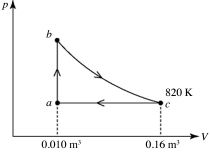
(Multiple Choice)
4.8/5 (81)
(81) A coal-fired plant generates 600 MW of electric power. The plant uses 4.8 × 10⁶ kg of coal each day. The heat produced by the combustion of coal is 3.3 × 10⁷ J/kg. The steam that drives the turbines is at a temperature of 300°C, and the exhaust water is at 37°C.
(a) What is the overall efficiency of the plant for generating electric power?
(b) What is the maximum efficiency that this plant could possibly have using the same temperature extremes that it presently uses?
(c) How much thermal energy is exhausted each day by this plant?
(Essay)
4.9/5 (79)
(79) An ideal reversible refrigerator keeps its inside compartment at 9.0°C. What is the high temperature, Th, needed to give this refrigerator a coefficient of performance of 3.7?
(Multiple Choice)
4.8/5 (78)
(78) A perfect Carnot engine operates between the temperatures of 300K and 700K, drawing 60 kJ of heat from the 700K reservoir in each cycle. How much heat is dumped into the 300K reservoir in each cycle?
(Multiple Choice)
4.7/5 (74)
(74) 
Filters
- Essay(0)
- Multiple Choice(0)
- Short Answer(0)
- True False(0)
- Matching(0)