



 Chat with AI
Exam 19: Heat Engines and Refrigerators

Exam 1: Concepts of Motion52 Questions
Exam 2: Kinematics in One Dimension59 Questions
Exam 3: Vectors and Coordinate Systems33 Questions
Exam 4: Kinematics in Two Dimensions50 Questions
Exam 5: Force and Motion31 Questions
Exam 6: Dynamics I: Motion Along a Line46 Questions
Exam 7: Newtons Third Law43 Questions
Exam 8: Dynamics Ii: Motion in a Plane20 Questions
Exam 9: Impulse and Momentum20 Questions
Exam 10: Energy43 Questions
Exam 11: Work100 Questions
Exam 12: Rotation of a Rigid Body113 Questions
Exam 13: Newtons Theory of Gravity50 Questions
Exam 14: Oscillations49 Questions
Exam 15: Fluids and Elasticity72 Questions
Exam 16: A Macroscopic Description of Matter29 Questions
Exam 17: Work, Heat, and the First Law of Thermodynamics98 Questions
Exam 18: The Micromacro Connection39 Questions
Exam 19: Heat Engines and Refrigerators50 Questions
Exam 20: Traveling Waves49 Questions
Exam 21: Superpositions64 Questions
Exam 22: Wave Optics51 Questions
Exam 23: Ray Optics63 Questions
Exam 24: Optical Instruments49 Questions
Exam 25: Electric Charges and Forces26 Questions
Exam 26: The Electric Field32 Questions
Exam 27: Gausss Law41 Questions
Exam 28: The Electric Potential40 Questions
Exam 29: Potential and Field57 Questions
Exam 30: Current and Resistance32 Questions
Exam 31: Fundamentals of Circuits68 Questions
Exam 32: The Magnetic Field87 Questions
Exam 33: Electromagnetic Induction66 Questions
Exam 34: Electromagnetic Fields and Waves52 Questions
Exam 35: Ac Circuits46 Questions
Exam 36: Relativity49 Questions
Exam 37: The Foundations of Modern Physics8 Questions
Exam 38: Quantization54 Questions
Exam 39: Wave Functions and Uncertainty18 Questions
Exam 40: One-Dimensional Quantum Mechanics32 Questions
Exam 41: Atomic Physics39 Questions
Exam 42: Nuclear Physics65 Questions
Select questions type


Is it possible to transfer heat from a cold reservoir to a hot reservoir?
(Multiple Choice)
4.8/5  (81)
(81) As a result of any natural process, the total entropy of any system plus that of its environment
(Multiple Choice)
4.8/5 (80)
(80) A Carnot engine operates between a high temperature reservoir at 435 K and a river with water at 280 K. If it absorbs 3700 J of heat each cycle, how much work per cycle does it perform?
(Multiple Choice)
4.9/5 (75)
(75) A 2.00 kg piece of lead at 40.0°C is placed in a very large quantity of water at 10.0°C, and thermal equilibrium is eventually reached. Calculate the entropy change of the lead that occurs during this process. The specific heat of lead is 130 J/(kg∙K).
(Multiple Choice)
4.8/5 (83)
(83) During each cycle of operation, a refrigerator absorbs 230 J of heat from the freezer and expels 356 J of heat to the room. How much work input is required in each cycle?
(Multiple Choice)
4.9/5 (83)
(83) The graph in the figure shows a cycle for a heat engine for which QH=35 J. What is the thermal efficiency of this engine? 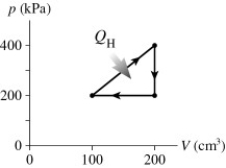
(Multiple Choice)
4.9/5 (79)
(79) A refrigerator has a coefficient of performance of 1.15, and it extracts 7.95 J of heat from the cold reservoir during each cycle.
(a) How much work is done on the gas in each cycle?
(b) How much heat is exhausted into the hot reservoir in each cycle?
(Essay)
4.7/5 (75)
(75) An ideal Carnot engine operates between reservoirs having temperatures of 125°C and -20°C. Each cycle the heat expelled by this engine is used to melt 30.0 g of ice at 0.00°C. The heat of fusion of water is 3.34 × 10⁵ J/kg and the heat of vaporization of water is 2.25 × 10⁶ J/kg.
(a) How much work does this engine do each cycle?
(b) How much heat per cycle does this engine absorb at the hot reservoir?
(Essay)
4.8/5 (80)
(80) What is the change in entropy of 10.0 moles of ideal monatomic gas that reversibly undergoes the isothermal expansion shown in the figure? The ideal gas constant is R = 8.314 J/(mol∙K). 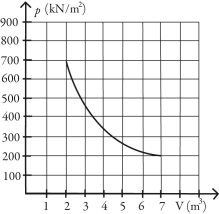
(Multiple Choice)
4.9/5 (73)
(73) An engine manufacturer makes the claim that the engine they have developed will, on each cycle, take 100 J of heat out of boiling water at 100°C, do mechanical work of 80 J, and exhaust 20 J of heat at 10°C. What, if anything, is wrong with this claim?
(Multiple Choice)
4.9/5 (86)
(86) A certain engine extracts 1300 J of heat from a hot temperature reservoir and discharges 700 J of heat to a cold temperature reservoir. What is the efficiency of this engine?
(Multiple Choice)
4.8/5 (85)
(85) A Carnot refrigerator has a coefficient of performance of 2.5. The refrigerator consumes 50 W of power. How much heat is removed from the interior of the refrigerator in 1 hour?
(Multiple Choice)
5.0/5 (95)
(95) A refrigerator has a coefficient of performance equal to 4.2. How much work must be done on the refrigerator in order to remove 250 J of heat from the interior?
(Multiple Choice)
5.0/5 (73)
(73) You want to design an ideal Carnot heat engine that wastes only 35.0% of the heat that goes into it. The lowest cold-reservoir temperature available to you is +15.0°C. If 150.0 J of work is done per cycle, the heat input per cycle is closest to
(Multiple Choice)
4.8/5 (91)
(91) One of the most efficient engines built so far has the following characteristics:
combustion chamber temperature = 1900°C
exhaust temperature = 430°C
7.0 × 10⁹ cal of fuel produces 1.4 × 10¹⁰ J of work in one hour, where 1 cal = 4.19 J
(a) What is the actual efficiency of this engine?
(b) What is the Carnot efficiency of the engine?
(c) What is the power output of this engine?
(Essay)
4.8/5 (64)
(64) A nuclear fission power plant has an actual efficiency of 39%. If 0.25 MW of power are produced by the nuclear fission, how much electric power does the power plant output?
(Multiple Choice)
4.9/5 (86)
(86) An air conditioner with a coefficient of performance of 3.5 uses 30 kW of power. How much power is it discharging to the outdoors?
(Multiple Choice)
5.0/5 (80)
(80) A certain Carnot heat pump transfers energy from the outside of a house, where the temperature is -15°C, to the inside of a room where the temperature is 21°C. If this heat pump runs off of electricity, what is the minimum rate at which it uses electrical energy to deliver 150 W to the inside room?
(Short Answer)
4.9/5 (87)
(87) A Carnot engine is operated as a heat pump to heat a room in the winter. The heat pump delivers heat to the room at the rate of 34 kJ per second and maintains the room at a temperature of 293 K when the outside temperature is 229 K. The power requirement for the heat pump under these operating conditions is closest to
(Multiple Choice)
5.0/5 (79)
(79) A 610-g quantity of an ideal gas undergoes a reversible isothermal compression at a temperature of 330 K. The compression reduces the volume of the gas from 0.40 m3 initially, to 0.21 m3 finally. The molecular mass of the gas is 33.0 g/mol and the ideal gas constant is R = 8.314 J/(mol∙K). The entropy change for the gas is closest to
(Multiple Choice)
4.9/5 (80)
(80) 
Filters
- Essay(0)
- Multiple Choice(0)
- Short Answer(0)
- True False(0)
- Matching(0)