



 Chat with AI
Exam 18: International Trade and Public Policy

Exam 1: Introduction: What Is Economics163 Questions
Exam 2: The Key Principles of Economics199 Questions
Exam 3: Exchange and Markets136 Questions
Exam 4: Demand, supply, and Market Equilibrium280 Questions
Exam 5: Elasticity: a Measure of Responsiveness173 Questions
Exam 6: Market Efficiency and Government Intervention120 Questions
Exam 7: Consumer Choice: Utility Theory and Insights From Neuroscience116 Questions
Exam 8: Production Technology and Cost163 Questions
Exam 9: Perfect Competition165 Questions
Exam 10: Monopoly and Price Discrimination128 Questions
Exam 11: Market Entry and Monopolistic Competition114 Questions
Exam 12: Oligopoly and Strategic Behavior125 Questions
Exam 13: Controlling Market Power: Antitrust and Regulation84 Questions
Exam 14: Imperfect Information: Adverse Selection and Moral Hazard98 Questions
Exam 15: Public Goods and Public Choice97 Questions
Exam 16: External Costs and Environmental Policy109 Questions
Exam 17: The Labor Market and the Distribution of Income178 Questions
Exam 18: International Trade and Public Policy229 Questions
Select questions type


Daily Output of Scotland and Poland
 Table 18.1
-Refer to Table 18.1.If Poland produces 50 bagpipes,how many accordions can they produce for the rest of the day?
Table 18.1
-Refer to Table 18.1.If Poland produces 50 bagpipes,how many accordions can they produce for the rest of the day? (Multiple Choice)
4.8/5  (80)
(80) Consider the following daily production possibilities of apples and bananas in Ireland and Scotland: 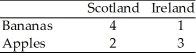 Supposed that the production of apples require skilled workers while the bananas require unskilled workers.If Scotland and Ireland choose to trade with each other in order to take advantage of their opportunity costs:
a)Who will sell bananas? Who will sell Apples?
b)Which worker will gain in Scotland? Which worker will be hurt?
Supposed that the production of apples require skilled workers while the bananas require unskilled workers.If Scotland and Ireland choose to trade with each other in order to take advantage of their opportunity costs:
a)Who will sell bananas? Who will sell Apples?
b)Which worker will gain in Scotland? Which worker will be hurt? (Essay)
4.7/5 (82)
(82) If the opportunity cost of a table is 5 chairs in nation A and 1 chair in nation B,it makes sense for nation A to produce chairs.
(True/False)
4.8/5 (66)
(66) Suppose the United States produces only two goods,textiles and computer chips.If the United States has a comparative advantage in computer chips,a move toward free trade will:
(Multiple Choice)
4.8/5 (76)
(76)  Figure 18.1
-Refer to Figure 18.1.In autarky,the maximum amount of sunglasses that Duckland can produce is:
Figure 18.1
-Refer to Figure 18.1.In autarky,the maximum amount of sunglasses that Duckland can produce is: (Multiple Choice)
4.9/5 (82)
(82) The production possibilities curve represents the set of all:
(Multiple Choice)
4.9/5 (75)
(75) Which of the following explains why the world market may support only one or two firms worldwide?
(Multiple Choice)
4.8/5 (80)
(80) The U.S.has a lot of both skilled and unskilled workers in the economy.Suppose that the U.S.'s comparative advantage is in industries that require more skilled workers.Instead of using protectionist policies,what other policy can the government use to dampen the negative effects unskilled workers may face a result of free trade?
(Essay)
4.8/5 (69)
(69) Trade theory suggests that increased trade leads to increased wage inequality.
(True/False)
4.8/5 (88)
(88) If France can produce grapes at a lower opportunity cost than any other nation,France is said to have a(n)________ in the production of grapes.
(Multiple Choice)
4.7/5 (74)
(74) According to the application,examples of non-durable goods include:
(Multiple Choice)
4.8/5 (63)
(63) A possible reason to impose a protectionist policy such as a tariff is to:
(Multiple Choice)
4.7/5 (78)
(78) The APEC (Asia Pacific Economic Cooperation)has more members than the EU.
(True/False)
4.8/5 (90)
(90) According to the Application,what effects of the Chinese imports were advantageous to local communities?
(Multiple Choice)
4.8/5 (86)
(86) Which of the following organizations has over 149 member nations and oversees the General Agreement on Trade and Tariffs?
(Multiple Choice)
4.8/5 (65)
(65) The opportunity cost of a table is 5 chairs in nation A and 4 chairs in nation B.If the nations specialize and trade,an acceptable terms of trade for both nations would be 3 chairs per table.
(True/False)
4.8/5 (81)
(81) 
Filters
- Essay(0)
- Multiple Choice(0)
- Short Answer(0)
- True False(0)
- Matching(0)