



 Chat with AI
Exam 18: International Trade and Public Policy

Exam 1: Introduction: What Is Economics163 Questions
Exam 2: The Key Principles of Economics199 Questions
Exam 3: Exchange and Markets136 Questions
Exam 4: Demand, supply, and Market Equilibrium280 Questions
Exam 5: Elasticity: a Measure of Responsiveness173 Questions
Exam 6: Market Efficiency and Government Intervention120 Questions
Exam 7: Consumer Choice: Utility Theory and Insights From Neuroscience116 Questions
Exam 8: Production Technology and Cost163 Questions
Exam 9: Perfect Competition165 Questions
Exam 10: Monopoly and Price Discrimination128 Questions
Exam 11: Market Entry and Monopolistic Competition114 Questions
Exam 12: Oligopoly and Strategic Behavior125 Questions
Exam 13: Controlling Market Power: Antitrust and Regulation84 Questions
Exam 14: Imperfect Information: Adverse Selection and Moral Hazard98 Questions
Exam 15: Public Goods and Public Choice97 Questions
Exam 16: External Costs and Environmental Policy109 Questions
Exam 17: The Labor Market and the Distribution of Income178 Questions
Exam 18: International Trade and Public Policy229 Questions
Select questions type


Daily Output of Japan and U.S.
 Table 18.2
-Refer to Table 18.2.The nation with a comparative advantage in tractors is:
Table 18.2
-Refer to Table 18.2.The nation with a comparative advantage in tractors is: (Multiple Choice)
4.8/5  (74)
(74)  Figure 18.4
-Refer to Figure 18.4.With a tariff or quota,what is the equilibrium quantity of artichokes in Duckland?
Figure 18.4
-Refer to Figure 18.4.With a tariff or quota,what is the equilibrium quantity of artichokes in Duckland? (Multiple Choice)
4.9/5 (74)
(74)  Figure 18.5
-For the good in Figure 18.5,with the tariff,the people in the country will buy:
Figure 18.5
-For the good in Figure 18.5,with the tariff,the people in the country will buy: (Multiple Choice)
4.7/5 (81)
(81) Which of the following is a problem of subsidizing an industry to help it establish a world monopoly?
(Multiple Choice)
4.8/5 (89)
(89)  Figure 18.3
-Refer to Figure 18.3.With an import ban,the equilibrium quantity is:
Figure 18.3
-Refer to Figure 18.3.With an import ban,the equilibrium quantity is: (Multiple Choice)
4.8/5 (83)
(83) Suppose Canada produces only two goods,corn and automobiles.If Canada has a comparative advantage in automobiles,a move toward free trade will:
(Multiple Choice)
4.7/5 (81)
(81)  Figure 18.2
-Refer to Figure 18.2.In autarky,the maximum amount of tomatoes that Pizzaland can produce is:
Figure 18.2
-Refer to Figure 18.2.In autarky,the maximum amount of tomatoes that Pizzaland can produce is: (Multiple Choice)
4.8/5 (70)
(70) As a whole,nations are better off after trade and specialization because:
(Multiple Choice)
4.8/5 (73)
(73)  Figure 18.1
-Refer to Figure 18.1.After trade and specialization begin,the maximum amount of umbrellas that Duckland can consume is:
Figure 18.1
-Refer to Figure 18.1.After trade and specialization begin,the maximum amount of umbrellas that Duckland can consume is: (Multiple Choice)
4.9/5 (83)
(83) Because U.S.tariffs are higher on textiles,footwear and apparel items,U.S.tariffs fall relatively most heavily on:
(Multiple Choice)
4.9/5 (77)
(77) Figure 18.1
-Refer to Figure 18.1.The opportunity cost of producing sunglasses in Duckland is:
Figure 18.1
-Refer to Figure 18.1.The opportunity cost of producing sunglasses in Duckland is: (Multiple Choice)
4.9/5 (75)
(75) Consider the following weekly production possibilities of bagpipes and accordions in Poland and Scotland: 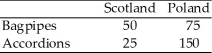 What is each country's opportunity cost of producing bagpipes and accordions? If the countries could,should they trade?
 (Essay)
5.0/5 (63)
(63) If a country bans the importation of a particular good,the market equilibrium is shown by the intersection of the demand and domestic supply curves.
(True/False)
4.8/5 (80)
(80) Which of the following trade policies will prevent a foreign supplier to sell even one unit of the good in the domestic market?
(Multiple Choice)
4.9/5 (80)
(80) Suppose nation A produces only two goods,apples and oranges.If nation A produces only apples,it can make 12 apples per day.If nation A produces only oranges,it can make 36 oranges per day.If the country has a constant production trade-off between apples and oranges,then the opportunity cost of one orange in nation A is:
(Multiple Choice)
4.8/5 (80)
(80) Daily Output of Japan and U.S.
Table 18.2
-Refer to Table 18.2.The opportunity cost of stereos in the U.S.is:
Table 18.2
-Refer to Table 18.2.The opportunity cost of stereos in the U.S.is: (Multiple Choice)
4.7/5 (70)
(70) According to the Application,what effects of the Chinese imports were advantageous to local communities,but is usually not included in the study done by Autor,Dorn and Hanson?
(Multiple Choice)
4.8/5 (80)
(80) According to the infant industry argument for trade protectionism:
(Multiple Choice)
4.7/5 (64)
(64) The World Trade Organization was formed to enforce GATT and other international trade agreements.
(True/False)
4.8/5 (74)
(74) 
Filters
- Essay(0)
- Multiple Choice(0)
- Short Answer(0)
- True False(0)
- Matching(0)