



 Chat with AI
Exam 18: International Trade and Public Policy

Exam 1: Introduction: What Is Economics163 Questions
Exam 2: The Key Principles of Economics199 Questions
Exam 3: Exchange and Markets136 Questions
Exam 4: Demand, supply, and Market Equilibrium280 Questions
Exam 5: Elasticity: a Measure of Responsiveness173 Questions
Exam 6: Market Efficiency and Government Intervention120 Questions
Exam 7: Consumer Choice: Utility Theory and Insights From Neuroscience116 Questions
Exam 8: Production Technology and Cost163 Questions
Exam 9: Perfect Competition165 Questions
Exam 10: Monopoly and Price Discrimination128 Questions
Exam 11: Market Entry and Monopolistic Competition114 Questions
Exam 12: Oligopoly and Strategic Behavior125 Questions
Exam 13: Controlling Market Power: Antitrust and Regulation84 Questions
Exam 14: Imperfect Information: Adverse Selection and Moral Hazard98 Questions
Exam 15: Public Goods and Public Choice97 Questions
Exam 16: External Costs and Environmental Policy109 Questions
Exam 17: The Labor Market and the Distribution of Income178 Questions
Exam 18: International Trade and Public Policy229 Questions
Select questions type


What are the similarities and differences between an import tariff and a voluntary export restraint? What are the differences?
(Essay)
4.9/5  (69)
(69) Among the rationales for protection is that it helps the domestic economy grow.
(True/False)
4.7/5 (72)
(72) Daily Output of Japan and U.S.
 Table 18.2
-Refer to Table 18.2.The opportunity cost of tractors in Japan is:
Table 18.2
-Refer to Table 18.2.The opportunity cost of tractors in Japan is: (Multiple Choice)
4.8/5 (75)
(75)  Figure 18.5
-In Figure 18.5,compared to free trade,the tariff causes domestic production of the good to:
Figure 18.5
-In Figure 18.5,compared to free trade,the tariff causes domestic production of the good to: (Multiple Choice)
4.9/5 (78)
(78) If a firm charges a foreign market a lower price than it charges the domestic market that firm is said to be ________ its product.
(Multiple Choice)
4.9/5 (78)
(78) Consider a nation that has a comparative advantage in the production of goods using unskilled labor.What types of workers will benefit from increased trade,and what type will lose?
(Essay)
4.8/5 (76)
(76) Consider the following weekly production possibilities of bagpipes and accordions in Poland and Scotland: 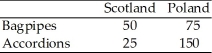 What is the possible range of terms of trade between Poland and Scotland?
 (Essay)
4.8/5 (89)
(89)  Figure 18.4
-Refer to Figure 18.4.With an import ban,how many artichokes are produced domestically in Duckland?
Figure 18.4
-Refer to Figure 18.4.With an import ban,how many artichokes are produced domestically in Duckland? (Multiple Choice)
4.8/5 (84)
(84) Daily Output of Japan and U.S.
Table 18.2
-Refer to Table 18.2.After trade begins,________ will specialize in the production of stereos and ________ will specialize in the production of tractors.
Table 18.2
-Refer to Table 18.2.After trade begins,________ will specialize in the production of stereos and ________ will specialize in the production of tractors. (Multiple Choice)
4.8/5 (74)
(74) Which of the following groups of countries are members of NAFTA?
(Multiple Choice)
4.7/5 (90)
(90) The increase in the U.S trade deficit with Mexico after NAFTA went into effect was most likely the result of:
(Multiple Choice)
4.9/5 (84)
(84) The difficulty with enforcing anti-dumping laws is that predatory pricing is difficult to determine if the lower price is due to:
(Multiple Choice)
4.8/5 (84)
(84)  Figure 18.2
-Refer to Figure 18.2.After trade and specialization begin,the maximum amount of tomatoes that Pizzaland can consume is:
Figure 18.2
-Refer to Figure 18.2.After trade and specialization begin,the maximum amount of tomatoes that Pizzaland can consume is: (Multiple Choice)
4.9/5 (85)
(85) Daily Output of Scotland and Poland
 Table 18.1
-Refer to Table 18.1.If Scotland produces 50 bagpipes,how many accordions can they produce for the rest of the day?
Table 18.1
-Refer to Table 18.1.If Scotland produces 50 bagpipes,how many accordions can they produce for the rest of the day? (Multiple Choice)
4.8/5 (85)
(85) Daily Output of Scotland and Poland
Table 18.1
-Refer to Table 18.1.Poland has a comparative advantage in:
Table 18.1
-Refer to Table 18.1.Poland has a comparative advantage in: (Multiple Choice)
4.9/5 (83)
(83) Which of the following situations will arise in the domestic market following the removal of an import quota?
(Multiple Choice)
4.9/5 (77)
(77) Dumping is sometimes legal under international trade agreements.
(True/False)
4.9/5 (90)
(90) 
Filters
- Essay(0)
- Multiple Choice(0)
- Short Answer(0)
- True False(0)
- Matching(0)