



 Chat with AI
Exam 2: Economic Models: Trade-Offs and Trade

Exam 1: First Principles199 Questions
Exam 2: Economic Models: Trade-Offs and Trade299 Questions
Exam 4: Consumer and Producer Surplus229 Questions
Exam 3: Supply and Demand265 Questions
Exam 5: Price Controls and Quotas: Meddling With Markets216 Questions
Exam 6: Elasticity226 Questions
Exam 7: Taxes286 Questions
Exam 8: International Trade260 Questions
Exam 9: Decision Making by Individuals and Firms186 Questions
Exam 10: The Rational Consumer182 Questions
Exam 11: Behind the Supply Curve: Inputs and Costs317 Questions
Exam 12: Perfect Competition and the Supply Curve341 Questions
Exam 13: Monopoly317 Questions
Exam 14: Oligopoly271 Questions
Exam 15: Monopolistic Competition and Product Differentiation245 Questions
Exam 16: Externalities193 Questions
Exam 17: Public Goods and Common Resources208 Questions
Exam 18: The Economics of the Welfare State126 Questions
Exam 19: Factor Markets and the Distribution of Income316 Questions
Exam 20: Uncertainty, Risk, and Private Information192 Questions
Exam 21: Graphs in Economics60 Questions
Exam 22: Consumer Preferences and Consumer Choice135 Questions
Select questions type


Use the following to answer question:
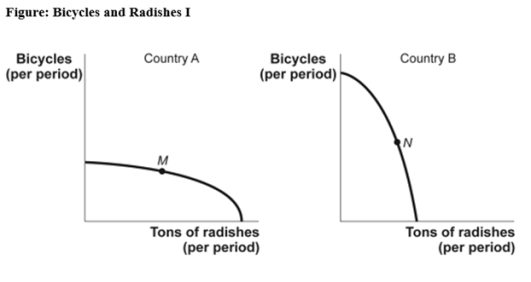 -(Figure: Bicycles and Radishes I)Use Figure: Bicycles and Radishes I.The figure shows the production possibility frontiers for two countries that produce only radishes and bicycles.The axes of the two graphs are measured in equivalent units.Country A is operating at point M,and country B is operating at point N.The opportunity cost of producing an additional ton of radishes would be greater in:
 (Multiple Choice)
4.8/5  (70)
(70) Use the following to answer question:
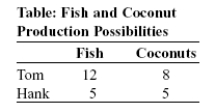 -(Table: Fish and Coconut Production Possibilities)Use Table: Fish and Coconut Production Possibilities.The table shows the maximum number of fish or coconuts that Tom and Hank can produce when each produces only one of the goods.The table implies that Tom has a comparative advantage in the production of both goods.
 (True/False)
4.9/5 (65)
(65) Economists usually assume that production is subject to increasing opportunity costs because:
(Multiple Choice)
4.9/5 (77)
(77) Use the following to answer question: 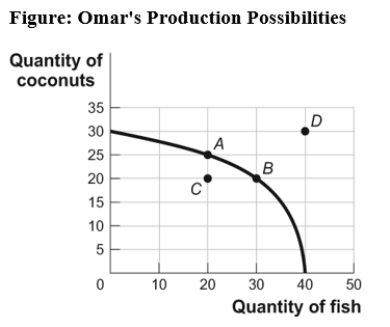 -(Figure: Omar's Production Possibilities)Use Figure: Omar's Production Possibilities.Which point or points represent(s)an infeasible combination of coconuts and fish?
 (Multiple Choice)
4.7/5 (72)
(72) Use the following to answer question:
 -(Figure: Strawberries and Submarines II)Use Figure: Strawberries and Submarines II.Point F is:
 (Multiple Choice)
4.9/5 (69)
(69) Use the following to answer question: 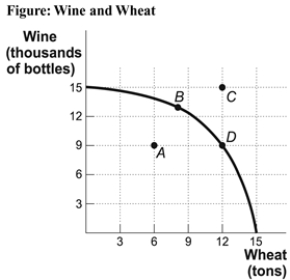 -(Figure: Wine and Wheat)Use Figure: Wine and Wheat.If this economy is producing at point A,we know the economy is:
 (Multiple Choice)
4.9/5 (84)
(84) As long as people have different _____,everyone has a comparative advantage in something.
(Multiple Choice)
4.9/5 (93)
(93) An economic model is a simplified version of reality that is used to analyze real-world economic situations.
(True/False)
4.8/5 (78)
(78) Use the following to answer question: 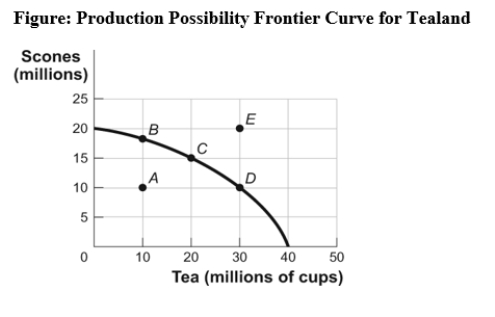 -(Figure: Production Possibility Frontier for Tealand)Use Figure: Production Possibility Frontier for Tealand.If Tealand is producing 10 million scones and 10 million cups of tea (point A),we know that the economy:
 (Multiple Choice)
4.7/5 (76)
(76) In movement along a production possibility frontier,the opportunity cost to society of getting more of one good:
(Multiple Choice)
4.9/5 (75)
(75) Jim is being paid $7.25 an hour to work at a restaurant.In the circular flow,this is an example of a:
(Multiple Choice)
4.7/5 (69)
(69) If they spend all night writing computer programs,Laurence can write 10 programs,and Carrie Anne can write 5.If they spend all night making sunglasses,Laurence can make 6 pairs,and Carrie Anne can make 4.We know that _____ has a comparative advantage in _____.
(Multiple Choice)
4.9/5 (78)
(78) If the production possibility frontier is a straight line:
(Multiple Choice)
4.9/5 (84)
(84) In the circular-flow diagram,an individual or a group of people (usually a family)who share their income is a(n):
(Multiple Choice)
4.8/5 (84)
(84) If the opportunity cost of manufacturing machinery is lower in the United States than in Britain and the opportunity cost of manufacturing sweaters is higher in the United States than in Britain,then the United States will:
(Multiple Choice)
4.9/5 (88)
(88) 
Filters
- Essay(0)
- Multiple Choice(0)
- Short Answer(0)
- True False(0)
- Matching(0)