



 Chat with AI
Exam 2: Economic Models: Trade-Offs and Trade

Exam 1: First Principles199 Questions
Exam 2: Economic Models: Trade-Offs and Trade299 Questions
Exam 4: Consumer and Producer Surplus229 Questions
Exam 3: Supply and Demand265 Questions
Exam 5: Price Controls and Quotas: Meddling With Markets216 Questions
Exam 6: Elasticity226 Questions
Exam 7: Taxes286 Questions
Exam 8: International Trade260 Questions
Exam 9: Decision Making by Individuals and Firms186 Questions
Exam 10: The Rational Consumer182 Questions
Exam 11: Behind the Supply Curve: Inputs and Costs317 Questions
Exam 12: Perfect Competition and the Supply Curve341 Questions
Exam 13: Monopoly317 Questions
Exam 14: Oligopoly271 Questions
Exam 15: Monopolistic Competition and Product Differentiation245 Questions
Exam 16: Externalities193 Questions
Exam 17: Public Goods and Common Resources208 Questions
Exam 18: The Economics of the Welfare State126 Questions
Exam 19: Factor Markets and the Distribution of Income316 Questions
Exam 20: Uncertainty, Risk, and Private Information192 Questions
Exam 21: Graphs in Economics60 Questions
Exam 22: Consumer Preferences and Consumer Choice135 Questions
Select questions type


Use the following to answer question:
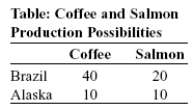 -(Table: Coffee and Salmon Production Possibilities)Use Table: Coffee and Salmon Production Possibilities.The table shows the maximum amounts of coffee and salmon that Brazil and Alaska can produce if they just produce one good.The opportunity cost of producing 1 unit of salmon for Alaska is _____ coffee(s).
 (Multiple Choice)
4.7/5  (90)
(90) Use the following to answer question:
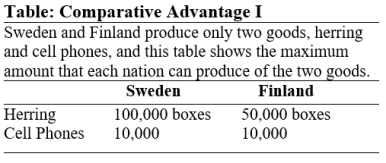 -(Table: Comparative Advantage I)Use Table: Comparative Advantage I.Finland has an absolute advantage in producing:
 (Multiple Choice)
5.0/5 (95)
(95) Mark and Julie are going to sell brownies and cookies for their third annual fundraiser bake sale.In one day,Mark can make 40 brownies or 20 cookies,and Julie can make 15 brownies or 15 cookies.Based on this information,_____ has the comparative advantage in making brownies and _____ has the comparative advantage in making cookies.
(Multiple Choice)
4.9/5 (81)
(81) Use the following to answer question:
 -(Figure: Guns and Butter)Use Figure: Guns and Butter.On this figure,points A,B,E,and F:
 (Multiple Choice)
4.7/5 (83)
(83) Use the following to answer question: 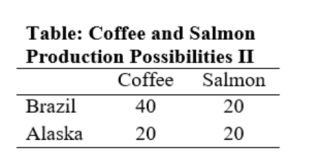 -(Table: Coffee and Salmon Production Possibilities II)Use Table: Coffee and Salmon Production Possibilities II.This table shows the maximum amounts of coffee and salmon,both measured in pounds,that Brazil and Alaska can produce if they just produce one good.Brazil has an absolute advantage in producing:
 (Multiple Choice)
4.8/5 (69)
(69) Economists use models to explain real-life situations because:
(Multiple Choice)
4.7/5 (80)
(80) In building models,economists often assume that opportunity costs don't matter.
(True/False)
4.9/5 (93)
(93) Use the following to answer question:
 -(Figure: Strawberries and Submarines)Use Figure: Strawberries and Submarines.Suppose the economy now operates at point C.Moving to point E would require that the economy:
 (Multiple Choice)
4.9/5 (84)
(84) In a single day,Sarah can produce 10 hamburgers,and Abe can produce 5 hamburgers.Therefore,_____ has a(n)_____ advantage in making hamburgers.
(Multiple Choice)
4.9/5 (70)
(70) Use the following to answer question:
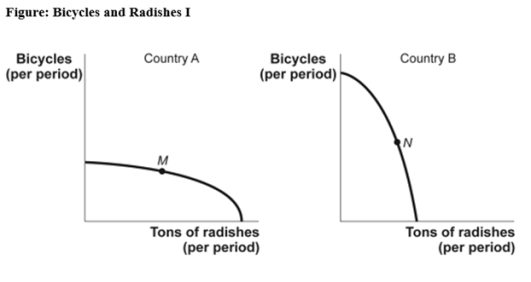 -(Figure: Bicycles and Radishes I)Use Figure: Bicycles and Radishes I.The figure shows production possibility frontiers for two countries that produce only radishes and bicycles.The axes of the two graphs are measured in equivalent units.Country A is operating at point M,and country B is operating at point N.Suppose country A discovers a new technology that greatly increases its ability to produce bicycles but has no effect on its ability to produce radishes.This would:
 (Multiple Choice)
4.8/5 (67)
(67) Use the following to answer question:
 -(Figure: Production Possibilities and Circular-Flow Diagram)Use Figure: Production Possibilities and Circular-Flow Diagram.Assume the two figures represent the same economy.Suppose that in the circular-flow diagram most firms undergo a significant increase in productivity.This results in a significant increase in the output of both coconuts and fish.If all other variables remain unchanged,then the adjustment in this economy would be BEST represented in the production possibilities figure by a movement from point A toward:
 (Multiple Choice)
4.8/5 (86)
(86) A simplified representation that is used to study a real situation is called a(n):
(Multiple Choice)
4.9/5 (82)
(82) Use the following to answer question:
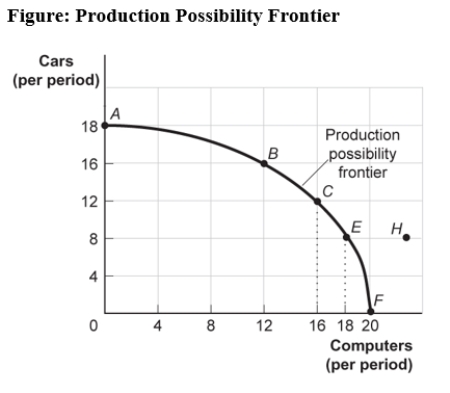 -(Figure: Production Possibility Frontier)Use Figure: Production Possibilities Frontier.The combination of cars and computers at point H:
 (Multiple Choice)
4.9/5 (96)
(96) 
Filters
- Essay(0)
- Multiple Choice(0)
- Short Answer(0)
- True False(0)
- Matching(0)