



 Chat with AI
Exam 20: International Finance

Exam 1: The Art and Science of Economic Analysis162 Questions
Exam 1: Appendix--Understanding Graphs71 Questions
Exam 2: Economic Tools and Economics Systems211 Questions
Exam 3: Economic Decision Makers207 Questions
Exam 4: Demand, Supply, and Markets245 Questions
Exam 5: Elasticity of Demand and Supply244 Questions
Exam 5: Appendix--Price Elasticity and Tax Incidence32 Questions
Exam 6: Consumer Choice and Demand171 Questions
Exam 6: Appendix--Indifference Curves and Utility Maximization107 Questions
Exam 7: Production and Cost in the Firm218 Questions
Exam 8: A--Perfect Competition250 Questions
Exam 8: B--Perfect Competition25 Questions
Exam 9: A--Monopoly249 Questions
Exam 9: B--Monopoly18 Questions
Exam 10: Monopolistic Competition and Oligopoly233 Questions
Exam 11: Resource Markets219 Questions
Exam 12: Labor Markets and Labor Unions218 Questions
Exam 13: Capital, Interest, and Corporate Finance190 Questions
Exam 14: Transaction Costs, Imperfect Information, and Behavioral Economics187 Questions
Exam 15: Economic Regulation and Antitrust Policy179 Questions
Exam 16: Public Goods and Public Choice143 Questions
Exam 17: Externalities and the Environment203 Questions
Exam 18: Income Distribution and Poverty130 Questions
Exam 19: International Trade172 Questions
Exam 20: International Finance226 Questions
Exam 21: Economic Development97 Questions
Select questions type


If a foreign currency becomes more expensive in United States dollars, we would expect
(Multiple Choice)
4.8/5  (84)
(84) Which of the following is not classified as a service in the current account?
(Multiple Choice)
4.9/5 (88)
(88) Exhibit 20-2  Given the data in Exhibit 20-2, what is the inflow of foreign capital into the United States?
 (Multiple Choice)
4.8/5 (71)
(71) Exhibit 20-3 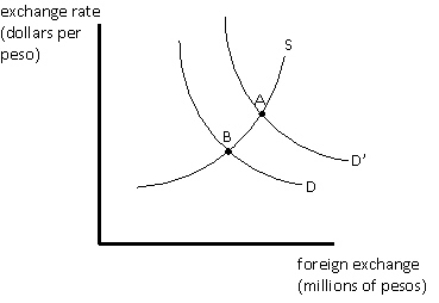 In Exhibit 20-3, all of the following except one would cause the demand for pesos to shift from D to D', except one.Which is the exception?
 (Multiple Choice)
4.9/5 (83)
(83) An increase in the U.S.demand for foreign exchange will cause a(n)
(Multiple Choice)
4.8/5 (80)
(80) The Bretton Woods system fixed all exchange rates in terms of the U.S.dollar.
(True/False)
4.9/5 (66)
(66) The breakdown of the Bretton Woods system occurred because
(Multiple Choice)
4.9/5 (73)
(73) Which of the following is not true of the statistical discrepancy in the balance of payments?
(Multiple Choice)
4.7/5 (73)
(73) A leftward shift of the Japanese demand curve for foreign exchange will
(Multiple Choice)
4.9/5 (79)
(79) If a country runs a deficit in its current account, it is because
(Multiple Choice)
4.8/5 (95)
(95) The balance of payments always balances, because each of the specific accounts must, by definition, be in balance.
(True/False)
4.8/5 (91)
(91) The international financial system operated under a gold standard
(Multiple Choice)
4.9/5 (85)
(85) Which of the following is not a reason why residents of other countries desire to acquire dollars?
(Multiple Choice)
4.9/5 (74)
(74) Under a floating rate system, exchange rates are determined by supply and demand in the foreign exchange market without government intervention.
(True/False)
4.7/5 (77)
(77) 
Filters
- Essay(0)
- Multiple Choice(0)
- Short Answer(0)
- True False(0)
- Matching(0)