



 Chat with AI
Exam 20: International Finance

Exam 1: The Art and Science of Economic Analysis162 Questions
Exam 1: Appendix--Understanding Graphs71 Questions
Exam 2: Economic Tools and Economics Systems211 Questions
Exam 3: Economic Decision Makers207 Questions
Exam 4: Demand, Supply, and Markets245 Questions
Exam 5: Elasticity of Demand and Supply244 Questions
Exam 5: Appendix--Price Elasticity and Tax Incidence32 Questions
Exam 6: Consumer Choice and Demand171 Questions
Exam 6: Appendix--Indifference Curves and Utility Maximization107 Questions
Exam 7: Production and Cost in the Firm218 Questions
Exam 8: A--Perfect Competition250 Questions
Exam 8: B--Perfect Competition25 Questions
Exam 9: A--Monopoly249 Questions
Exam 9: B--Monopoly18 Questions
Exam 10: Monopolistic Competition and Oligopoly233 Questions
Exam 11: Resource Markets219 Questions
Exam 12: Labor Markets and Labor Unions218 Questions
Exam 13: Capital, Interest, and Corporate Finance190 Questions
Exam 14: Transaction Costs, Imperfect Information, and Behavioral Economics187 Questions
Exam 15: Economic Regulation and Antitrust Policy179 Questions
Exam 16: Public Goods and Public Choice143 Questions
Exam 17: Externalities and the Environment203 Questions
Exam 18: Income Distribution and Poverty130 Questions
Exam 19: International Trade172 Questions
Exam 20: International Finance226 Questions
Exam 21: Economic Development97 Questions
Select questions type


If Europe and the United States were the only two regions in the world, then U.S.residents might desire to buy euros for all except one of the following reasons.Which is the exception?
(Multiple Choice)
4.7/5  (90)
(90) Which of the following is a partial explanation for why the PPP theory does not apply to the Big Mac Index?
(Multiple Choice)
5.0/5 (69)
(69) Critics of the current system of flexible exchange rates allege that it
(Multiple Choice)
4.9/5 (80)
(80) The balance of payments summarizes the transactions that occur during a given time period between
(Multiple Choice)
4.7/5 (78)
(78) Exhibit 20-8 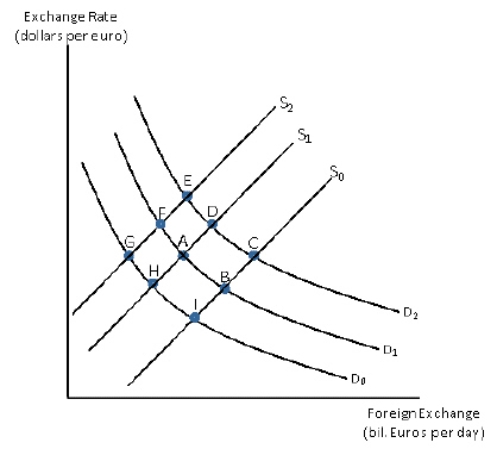 In Exhibit 20-8 a movement from point A to F represents a depreciation in the value of the euro.
 (True/False)
4.9/5 (77)
(77) Exhibit 20-4 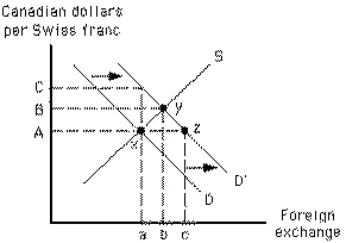 Suppose the Swiss government wants to set the exchange rate at A in Exhibit 20-4.The appropriate action for the government to take after the demand shift shown is
 (Multiple Choice)
5.0/5 (76)
(76) Which of the following best describes circumstances surrounding the breakdown of the Bretton Woods system?
(Multiple Choice)
4.8/5 (84)
(84) When net unilateral transfers are added to the net exports of goods and services, the result is called the
(Multiple Choice)
4.9/5 (69)
(69) A leftward shift of the European demand curve for foreign exchange will
(Multiple Choice)
4.9/5 (87)
(87) The theory that changes in the exchange rate reflect only changes in the price levels of two countries is called
(Multiple Choice)
4.7/5 (78)
(78) Exhibit 20-7 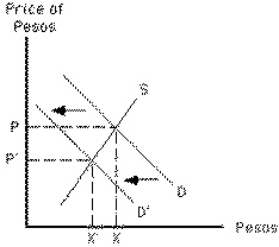 Imagine there are only two countries in the world, Mexico and Canada, and two currencies, pesos and Canadian dollars.If Mexico's central bank wants to protect its currency from depreciating in response to the demand shift shown in Exhibit 20-7, which of the following is most likely to be the policy it will choose?
 (Multiple Choice)
4.8/5 (79)
(79) The Bretton Woods agreement did all of the following except
(Multiple Choice)
4.9/5 (82)
(82) 
Filters
- Essay(0)
- Multiple Choice(0)
- Short Answer(0)
- True False(0)
- Matching(0)