



 Chat with AI
Exam 20: International Finance

Exam 1: The Art and Science of Economic Analysis162 Questions
Exam 1: Appendix--Understanding Graphs71 Questions
Exam 2: Economic Tools and Economics Systems211 Questions
Exam 3: Economic Decision Makers207 Questions
Exam 4: Demand, Supply, and Markets245 Questions
Exam 5: Elasticity of Demand and Supply244 Questions
Exam 5: Appendix--Price Elasticity and Tax Incidence32 Questions
Exam 6: Consumer Choice and Demand171 Questions
Exam 6: Appendix--Indifference Curves and Utility Maximization107 Questions
Exam 7: Production and Cost in the Firm218 Questions
Exam 8: A--Perfect Competition250 Questions
Exam 8: B--Perfect Competition25 Questions
Exam 9: A--Monopoly249 Questions
Exam 9: B--Monopoly18 Questions
Exam 10: Monopolistic Competition and Oligopoly233 Questions
Exam 11: Resource Markets219 Questions
Exam 12: Labor Markets and Labor Unions218 Questions
Exam 13: Capital, Interest, and Corporate Finance190 Questions
Exam 14: Transaction Costs, Imperfect Information, and Behavioral Economics187 Questions
Exam 15: Economic Regulation and Antitrust Policy179 Questions
Exam 16: Public Goods and Public Choice143 Questions
Exam 17: Externalities and the Environment203 Questions
Exam 18: Income Distribution and Poverty130 Questions
Exam 19: International Trade172 Questions
Exam 20: International Finance226 Questions
Exam 21: Economic Development97 Questions
Select questions type


A rightward shift of the Mexican demand curve for foreign exchange will
(Multiple Choice)
4.8/5  (90)
(90) Mary Green takes a summer course in London, England.She doesn't buy British pounds at the U.S.airport, where the rate is 1 pound = $1.60.Upon arrival in London, she finds that she can buy pounds for $1.65 each.Which of the following is true?
(Multiple Choice)
4.9/5 (87)
(87) In determining the exchange rate between the Canadian dollar and British pound, if Canadian income increases, then
(Multiple Choice)
4.8/5 (84)
(84) Contractionary policies help correct a balance of payments deficit by
(Multiple Choice)
4.9/5 (88)
(88) Speculators profit by taking risks, while the actions of arbitrageurs involve no risk.
(True/False)
4.9/5 (71)
(71) When the exchange rate is allowed to adjust to market forces, all of the following are true except one.Which is the exception?
(Multiple Choice)
4.9/5 (74)
(74) Under the gold standard, all except one of the following are true.Which is not true?
(Multiple Choice)
4.7/5 (79)
(79) Under a fixed exchange rate system, an increase in Japanese demand for U.S.agricultural goods would
(Multiple Choice)
4.8/5 (78)
(78) Assume the United States has only one trading partner.The U.S.demand curve for foreign currency is drawn while holding constant all of the following factors except one.Which is the exception?
(Multiple Choice)
4.8/5 (86)
(86) Exhibit 20-1  Given the hypothetical data in Exhibit 20-1, what is the balance on current account?
 (Multiple Choice)
4.8/5 (63)
(63) If the exchange rate changes from 75 cents per euro to $1 per euro, the euro
(Multiple Choice)
4.8/5 (72)
(72) Exhibit 20-4 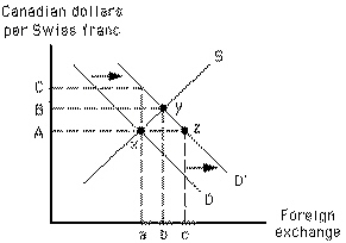 Which of the following is represented by Exhibit 20-4?
 (Multiple Choice)
4.7/5 (78)
(78) An increase in U.S.income that increases American demand for all normal goods (including imports from Britain)will shift
(Multiple Choice)
4.9/5 (75)
(75) International reserves include all except one of the following.Which is the exception?
(Multiple Choice)
4.9/5 (72)
(72) 
Filters
- Essay(0)
- Multiple Choice(0)
- Short Answer(0)
- True False(0)
- Matching(0)