



 Chat with AI
Exam 8: A--Perfect Competition

Exam 1: The Art and Science of Economic Analysis162 Questions
Exam 1: Appendix--Understanding Graphs71 Questions
Exam 2: Economic Tools and Economics Systems211 Questions
Exam 3: Economic Decision Makers207 Questions
Exam 4: Demand, Supply, and Markets245 Questions
Exam 5: Elasticity of Demand and Supply244 Questions
Exam 5: Appendix--Price Elasticity and Tax Incidence32 Questions
Exam 6: Consumer Choice and Demand171 Questions
Exam 6: Appendix--Indifference Curves and Utility Maximization107 Questions
Exam 7: Production and Cost in the Firm218 Questions
Exam 8: A--Perfect Competition250 Questions
Exam 8: B--Perfect Competition25 Questions
Exam 9: A--Monopoly249 Questions
Exam 9: B--Monopoly18 Questions
Exam 10: Monopolistic Competition and Oligopoly233 Questions
Exam 11: Resource Markets219 Questions
Exam 12: Labor Markets and Labor Unions218 Questions
Exam 13: Capital, Interest, and Corporate Finance190 Questions
Exam 14: Transaction Costs, Imperfect Information, and Behavioral Economics187 Questions
Exam 15: Economic Regulation and Antitrust Policy179 Questions
Exam 16: Public Goods and Public Choice143 Questions
Exam 17: Externalities and the Environment203 Questions
Exam 18: Income Distribution and Poverty130 Questions
Exam 19: International Trade172 Questions
Exam 20: International Finance226 Questions
Exam 21: Economic Development97 Questions
Select questions type


A perfectly competitive firm that should not shut down in the short run will maximize profit where
(Multiple Choice)
4.8/5  (79)
(79) Suppose a firm finds it is better off operating than shutting down in the short run.What is true at the quantity at which marginal cost equals marginal revenue?
(Multiple Choice)
5.0/5 (69)
(69) 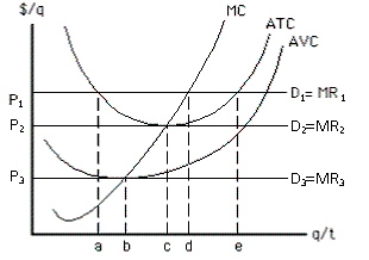 At output level a in Exhibit 8-6
Exhibit 8-8 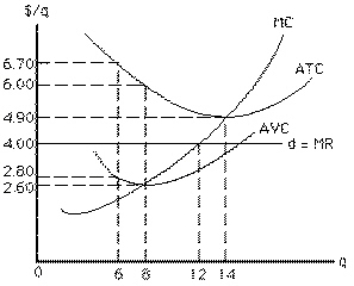 If the price-taking firm in Exhibit 8-8 is currently producing 6 units, then to maximize profit in the short run, it should
 (Multiple Choice)
4.9/5 (65)
(65) Exhibit 8-14 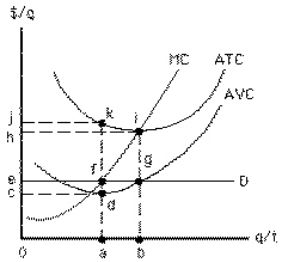 In Exhibit 8-14, what area represents fixed cost at the loss-minimizing output?
 (Multiple Choice)
4.8/5 (83)
(83) Exhibit 8-5  Consider Exhibit 8-5.Assume the firm is perfectly competitive and the market price is $21.To maximize profit or minimize loss, the firm will
 (Multiple Choice)
4.9/5 (87)
(87) Because market price remains constant as a perfectly competitive firm expands output, each firm faces
(Multiple Choice)
4.8/5 (77)
(77) A horizontal long-run industry supply curve occurs under conditions of
(Multiple Choice)
5.0/5 (74)
(74) Exhibit 8-11 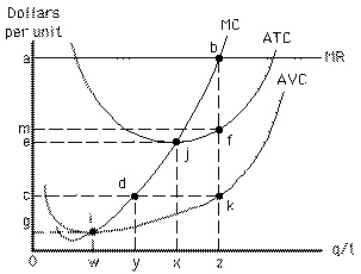 In Exhibit 8-11, the profit-maximizing output is
 (Multiple Choice)
4.9/5 (73)
(73) Exhibit 8-4  Consider Exhibit 8-4.If the market price is $8.50, what are the profit-maximizing output and profit?
 (Multiple Choice)
4.7/5 (76)
(76) The long-run supply curve for a constant-cost perfectly competitive industry is
(Multiple Choice)
4.8/5 (69)
(69) Exhibit 8-15 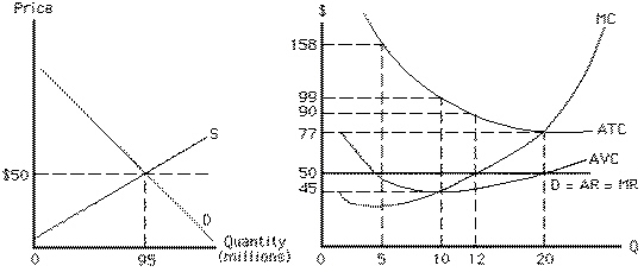 The purely competitive firm in Exhibit 8-15 should
 (Multiple Choice)
4.8/5 (81)
(81) Exhibit 8-1  The perfectly competitive firewood market is composed of 1, 000 identical consumers and 1, 000 identical firms.Exhibit 8-1 shows cost data for one firm and demand data for one consumer.How many cords of firewood wil be bought and sold in equilibrium?
 (Multiple Choice)
4.9/5 (74)
(74) A Midwestern wheat farmer faces a horizontal demand curve because
(Multiple Choice)
4.9/5 (83)
(83) Exhibit 8-18 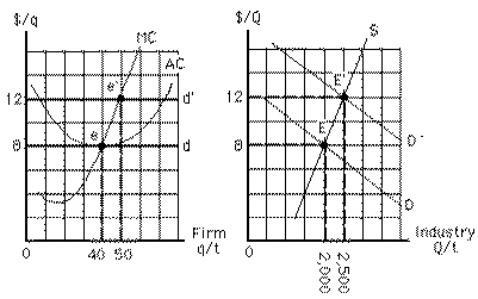 Assuming all of the firms are identical, how many firms are in the industry before and after the demand shift depicted in Exhibit 8-18?
 (Multiple Choice)
4.8/5 (59)
(59) Exhibit 8-5  Consider Exhibit 8-5.If the market price is $21, this perfectly competitive firm will
 (Multiple Choice)
4.7/5 (73)
(73) Suppose, as a result of a long-run adjustment in a perfectly competitive industry to a change in demand, price and output both rose.Therefore, demand must have __________ in this __________ industry
(Multiple Choice)
4.7/5 (76)
(76) 
Filters
- Essay(0)
- Multiple Choice(0)
- Short Answer(0)
- True False(0)
- Matching(0)