



 Chat with AI
Exam 8: A--Perfect Competition

Exam 1: The Art and Science of Economic Analysis162 Questions
Exam 1: Appendix--Understanding Graphs71 Questions
Exam 2: Economic Tools and Economics Systems211 Questions
Exam 3: Economic Decision Makers207 Questions
Exam 4: Demand, Supply, and Markets245 Questions
Exam 5: Elasticity of Demand and Supply244 Questions
Exam 5: Appendix--Price Elasticity and Tax Incidence32 Questions
Exam 6: Consumer Choice and Demand171 Questions
Exam 6: Appendix--Indifference Curves and Utility Maximization107 Questions
Exam 7: Production and Cost in the Firm218 Questions
Exam 8: A--Perfect Competition250 Questions
Exam 8: B--Perfect Competition25 Questions
Exam 9: A--Monopoly249 Questions
Exam 9: B--Monopoly18 Questions
Exam 10: Monopolistic Competition and Oligopoly233 Questions
Exam 11: Resource Markets219 Questions
Exam 12: Labor Markets and Labor Unions218 Questions
Exam 13: Capital, Interest, and Corporate Finance190 Questions
Exam 14: Transaction Costs, Imperfect Information, and Behavioral Economics187 Questions
Exam 15: Economic Regulation and Antitrust Policy179 Questions
Exam 16: Public Goods and Public Choice143 Questions
Exam 17: Externalities and the Environment203 Questions
Exam 18: Income Distribution and Poverty130 Questions
Exam 19: International Trade172 Questions
Exam 20: International Finance226 Questions
Exam 21: Economic Development97 Questions
Select questions type


Economic theory assumes that the goal of firms is to maximize
(Multiple Choice)
4.9/5  (79)
(79) Which of the following markets best approximates the perfectly competitive market structure?
(Multiple Choice)
4.9/5 (69)
(69) At its present rate of output, 200 units, a perfectly competitive firm has total cost of $10, 000, marginal cost of $38, and fixed cost of $2, 000, and it charges the market price of $38 per unit.To maximize profit or minimize loss, this firm should
(Multiple Choice)
4.9/5 (67)
(67) Exhibit 8-14 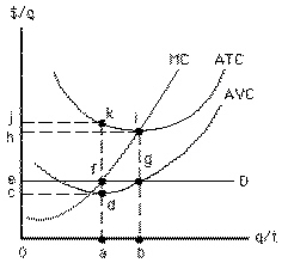 In Exhibit 8-14, what area represents total cost at the loss-minimizing output?
 (Multiple Choice)
4.7/5 (79)
(79) Peg's Kegs sells kegs in a perfectly competitive market.Because low demand forced price below average variable cost, Peg has made the short-run decision to shut down.Her current loss is
(Multiple Choice)
4.7/5 (83)
(83) If the loss-minimizing output for a perfectly competitive firm is zero, then, at all other output levels,
(Multiple Choice)
4.9/5 (73)
(73) Suppose a perfectly competitive constant-cost industry is in long-run equilibrium when market demand suddenly falls.What happens to the industry in the long run?
(Multiple Choice)
4.8/5 (83)
(83) 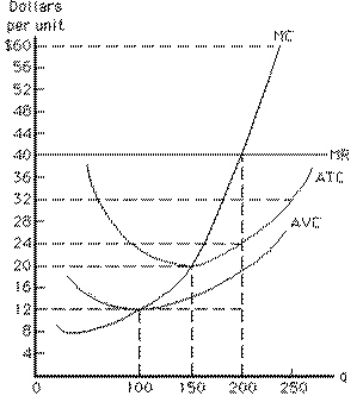 In Exhibit 8-10, price equals
A perfectly competitive firm finds that: Average total cost is $25;
Average variable cost is $15;
Marginal cost is $20 and increasing;
Price of the product is $22.
This firm should
(Multiple Choice)
4.9/5 (90)
(90) Firms in a perfectly competitive market achieve both allocative and productive efficiency in the short run
(True/False)
4.9/5 (77)
(77) Claude's Copper Clappers sells clappers for $65 each in a perfectly competitive market.At its present rate of output, Claude's marginal cost is $65, average variable cost is $45, and average total cost is $67.To maximize his profit or minimize his loss, Claude should
(Multiple Choice)
4.9/5 (88)
(88) Exhibit 8-9 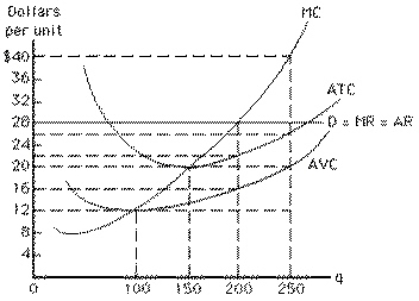 In Exhibit 8-9, total revenue at the profit-maximizing output equals
 (Multiple Choice)
4.9/5 (80)
(80) Firm A and B are producers in the same perfectly competitive industry.If Firm A earns a marginal revenue of $17,
(Multiple Choice)
4.8/5 (78)
(78) Exhibit 8-19 A Single Firm in a Perfectly Competitive Market 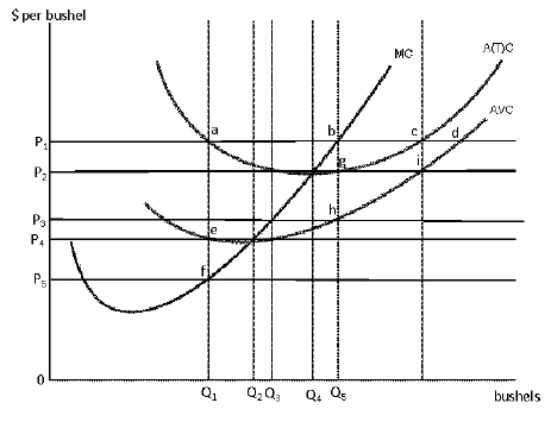 Exhibit 8-19 shows the demand and cost situation facing a single perfectly competitive firm.If P5 represents the equilibrium market price.What is the profit-maximizing quantity for the firm?
 (Multiple Choice)
4.9/5 (73)
(73) Exhibit 8-15 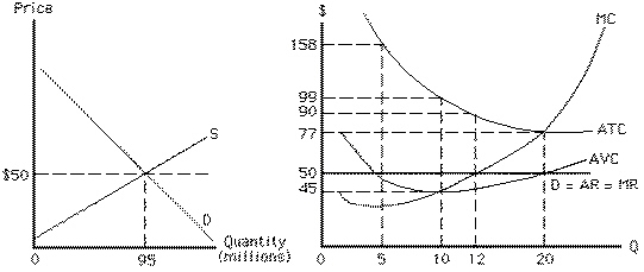 The maximum economic profit (or minimum economic loss)for the firm in Exhibit 8-15 is a
 (Multiple Choice)
4.7/5 (77)
(77) If every firm is a price taker, then which of the following characteristics does their industry have?
(Multiple Choice)
4.8/5 (95)
(95) Claude's Copper Clappers sells clappers for $60 each in a perfectly competitive market.At its present rate of output, Claude's marginal cost is $65, average variable cost is $25, and average total cost is $62.To improve his profit/loss situation, Claude should
(Multiple Choice)
4.8/5 (74)
(74) 
Filters
- Essay(0)
- Multiple Choice(0)
- Short Answer(0)
- True False(0)
- Matching(0)