



 Chat with AI
Exam 11: Reactions of Alcohols

Exam 1: Structure and Bonding127 Questions
Exam 2: Acids and Bases; Functional Groups136 Questions
Exam 3: Structure and Stereochemistry of Alkanes134 Questions
Exam 4: The Study of Chemical Reactions128 Questions
Exam 5: Stereochemistry132 Questions
Exam 6: Alkyl Halides; Nucleophilic Substitution137 Questions
Exam 7: Structure and Synthesis of Alkenes; Elimination131 Questions
Exam 8: Reactions of Alkenes134 Questions
Exam 10: Structure and Synthesis of Alcohols136 Questions
Exam 11: Reactions of Alcohols125 Questions
Exam 12: Infrared Spectroscopy and Mass Spectrometry121 Questions
Exam 13: Nuclear Magnetic Resonance Spectroscopy130 Questions
Exam 14: Ethers, Epoxides, and Thioethers127 Questions
Exam 15: Conjugated Systems, Orbital Symmetry, and Ultraviolet Spectroscopy130 Questions
Exam 16: Aromatic Compounds128 Questions
Exam 17: Reactions of Aromatic Compounds129 Questions
Exam 18: Ketones and Aldehydes131 Questions
Exam 19: Amines127 Questions
Exam 20: Carboxylic Acids125 Questions
Exam 21: Carboxylic Acid Derivatives130 Questions
Exam 22: Condensations and Alpha Substitutions of Carboxyl Compounds127 Questions
Exam 23: Carbohydrates and Nucleic Acids126 Questions
Exam 24: Amino Acids, Peptides, and Proteins127 Questions
Exam 25: Lipids127 Questions
Exam 26: Synthetic Polymers128 Questions
Select questions type


What series of synthetic steps could be used to carry out the transformation shown below? 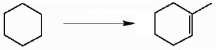
(Essay)
4.8/5  (86)
(86) 
The oxidation of a secondary alcohol with NaOCl in acetic acid proceeds through the reaction of the alcohol with the reactive intermediate ClOH2+. Write a mechanism that shows how isopropyl alcohol is oxidized to acetone (CH3COCH3) using ClOH2+ in acetic acid (CH3COOH).
(Essay)
4.9/5 (83)
(83) 
In the chromic acid oxidation of alcohols, the chromium is ________.
(Multiple Choice)
4.8/5 (77)
(77) 
What is the major organic product of the following reaction? 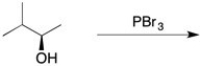
(Multiple Choice)
4.8/5 (84)
(84) 
Complete the following reaction by filling in the necessary reagents. 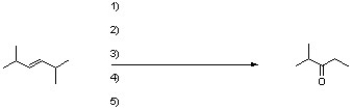
(Essay)
4.9/5 (75)
(75) Provide the name of the major organic product that results when (R)-2-butyl tosylate is treated with sodium iodide.
(Short Answer)
4.9/5 (73)
(73) Predict the major product of the reaction below and provide a stepwise mechanism which accounts for its formation.
(CH3)3CCH2OH + HBr →
(Essay)
4.8/5 (78)
(78) 
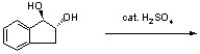
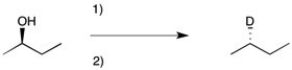
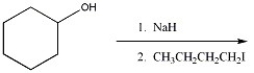
Provide the structure of the major organic product in the reaction below.
(CH3)2CHCH2OH 
(Essay)
4.9/5 (82)
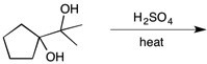
(82) Provide the structure of the major organic product in the reaction below. 
(Essay)
4.8/5 (91)
(91) Which of the following reagents is the best choice for oxidizing a primary alcohol to an aldehyde?
(Multiple Choice)
4.7/5 (82)
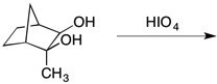
(82) Provide the structure of the major organic product in the reaction below. 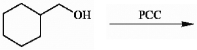
(Essay)
4.8/5 (79)
(79) 


Filters
- Essay(0)
- Multiple Choice(0)
- Short Answer(0)
- True False(0)
- Matching(0)