



 Chat with AI
Exam 11: Reactions of Alcohols

Exam 1: Structure and Bonding127 Questions
Exam 2: Acids and Bases; Functional Groups136 Questions
Exam 3: Structure and Stereochemistry of Alkanes134 Questions
Exam 4: The Study of Chemical Reactions128 Questions
Exam 5: Stereochemistry132 Questions
Exam 6: Alkyl Halides; Nucleophilic Substitution137 Questions
Exam 7: Structure and Synthesis of Alkenes; Elimination131 Questions
Exam 8: Reactions of Alkenes134 Questions
Exam 10: Structure and Synthesis of Alcohols136 Questions
Exam 11: Reactions of Alcohols125 Questions
Exam 12: Infrared Spectroscopy and Mass Spectrometry121 Questions
Exam 13: Nuclear Magnetic Resonance Spectroscopy130 Questions
Exam 14: Ethers, Epoxides, and Thioethers127 Questions
Exam 15: Conjugated Systems, Orbital Symmetry, and Ultraviolet Spectroscopy130 Questions
Exam 16: Aromatic Compounds128 Questions
Exam 17: Reactions of Aromatic Compounds129 Questions
Exam 18: Ketones and Aldehydes131 Questions
Exam 19: Amines127 Questions
Exam 20: Carboxylic Acids125 Questions
Exam 21: Carboxylic Acid Derivatives130 Questions
Exam 22: Condensations and Alpha Substitutions of Carboxyl Compounds127 Questions
Exam 23: Carbohydrates and Nucleic Acids126 Questions
Exam 24: Amino Acids, Peptides, and Proteins127 Questions
Exam 25: Lipids127 Questions
Exam 26: Synthetic Polymers128 Questions
Select questions type


Name the product which results when 1-methylcyclohexanol is treated with DMP reagent.
(Essay)
4.8/5  (71)
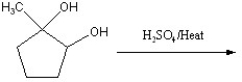
(71) 
Which of the following reaction series will result in the formation of a new secondary (2°) alcohol from the beginning alcohol listed at the top?
(Multiple Choice)
5.0/5 (85)
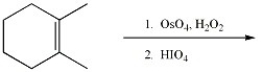
(85) 
What series of synthetic steps could be used to prepare (CH3)2CHCHO from (CH3)3CH?
(Essay)
4.9/5 (79)
(79) Provide the name of the major organic product that results when (R)-2-methyl-3-pentanol is heated with conc. H2SO4.
(Short Answer)
4.9/5 (77)
(77) Which of the following oxidants will convert a primary alcohol to an aldehyde?
1) sodium dichromate /sulfuric acid 3) pyridinium chlorochromate
2) copper oxide 4) dimethylsulfoxide, oxalyl chloride
(Multiple Choice)
4.8/5 (77)
(77) Provide the structure of the major organic product in the reaction below.
(CH3)3CCH2CH2OH  →
→ (Essay)
4.9/5 (85)
(85) Which set of reagents will best convert 2,2-dimethylpropan-1-ol (neopentyl alcohol) to 4,4-dimethylpentan-2-ol?
(Multiple Choice)
4.8/5 (78)
(78) Which undergoes dehydration using concentrated H2SO4 faster, cyclopentanol or 1-methylcyclopentanol? Explain briefly.
(Essay)
4.8/5 (73)
(73) 
What compound is produced when (R)-pentan-2-ol is treated with TsCl followed by NaI?
(Multiple Choice)
4.8/5 (75)
(75) Provide the structure of the major organic product in the reaction below. 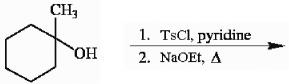
(Essay)
4.7/5 (73)
(73) What series of synthetic steps could be used to prepare hexan-3-ol from propan-1-ol?
1) PCC
2) CH3CH2CH2MgBr
3) H3O+
or
(Essay)
4.9/5 (67)
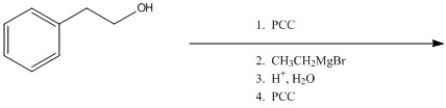
(67) 
Provide the name of the major organic product that results when trans-4-methylcyclohexanol is treated with thionyl chloride.
(Short Answer)
5.0/5 (84)
(84) What is the major organic product when n-butanol reacts with hydrochloric acid?
(Short Answer)
4.9/5 (83)
(83) Provide the name of the major organic product that results when cyclopentanol is treated with acetyl chloride.
(Short Answer)
4.8/5 (79)
(79) 

Filters
- Essay(0)
- Multiple Choice(0)
- Short Answer(0)
- True False(0)
- Matching(0)