



 Chat with AI
Exam 21: Carboxylic Acid Derivatives

Exam 1: Structure and Bonding127 Questions
Exam 2: Acids and Bases; Functional Groups136 Questions
Exam 3: Structure and Stereochemistry of Alkanes134 Questions
Exam 4: The Study of Chemical Reactions128 Questions
Exam 5: Stereochemistry132 Questions
Exam 6: Alkyl Halides; Nucleophilic Substitution137 Questions
Exam 7: Structure and Synthesis of Alkenes; Elimination131 Questions
Exam 8: Reactions of Alkenes134 Questions
Exam 10: Structure and Synthesis of Alcohols136 Questions
Exam 11: Reactions of Alcohols125 Questions
Exam 12: Infrared Spectroscopy and Mass Spectrometry121 Questions
Exam 13: Nuclear Magnetic Resonance Spectroscopy130 Questions
Exam 14: Ethers, Epoxides, and Thioethers127 Questions
Exam 15: Conjugated Systems, Orbital Symmetry, and Ultraviolet Spectroscopy130 Questions
Exam 16: Aromatic Compounds128 Questions
Exam 17: Reactions of Aromatic Compounds129 Questions
Exam 18: Ketones and Aldehydes131 Questions
Exam 19: Amines127 Questions
Exam 20: Carboxylic Acids125 Questions
Exam 21: Carboxylic Acid Derivatives130 Questions
Exam 22: Condensations and Alpha Substitutions of Carboxyl Compounds127 Questions
Exam 23: Carbohydrates and Nucleic Acids126 Questions
Exam 24: Amino Acids, Peptides, and Proteins127 Questions
Exam 25: Lipids127 Questions
Exam 26: Synthetic Polymers128 Questions
Select questions type


Provide a detailed, stepwise mechanism for the reaction of  with ammonia.
 (Essay)
4.8/5  (66)
(66) 
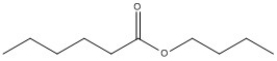
While the carbonyl stretching frequency for simple aldeydes, ketones, and carboxylic acids is about 1710 cm-1, the carbonyl stretching frequency for esters is about ________.
(Multiple Choice)
4.7/5 (78)
(78) 
Explain why alkoxides act as leaving groups in nucleophilic acyl substitutions but not in SN2 reactions.
(Essay)
5.0/5 (73)
(73) Which sequence ranks the following carboxylic acid derivatives in order of increasing rate of hydrolysis? 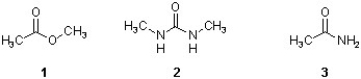
(Multiple Choice)
4.9/5 (81)
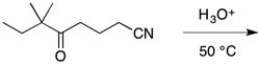
(81) 
Which of the following is the most reactive carboxylic acid derivative?
(Multiple Choice)
4.8/5 (75)
(75) Identify the correct IUPAC systematic name for the structure below. 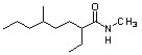
(Multiple Choice)
4.8/5 (78)
(78) Which of the following reagents convert(s) benzoyl chloride to phenyl propyl ketone?
(Multiple Choice)
4.9/5 (75)
(75) What type of compound results from the reaction of ethyl formate with cyclohexylamine?
(Multiple Choice)
4.9/5 (72)
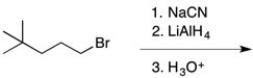
(72) 
Provide a detailed, stepwise mechanism for the acid-catalyzed transesterification of ethyl acetate with n-propanol.
(Essay)
4.9/5 (77)
(77) Give two different one-step methods to convert propanoic acid to methyl propanoate.
(Essay)
4.9/5 (89)
(89) Arrange the following compounds in order of increasing boiling point: acetic acid, propanenitrile, butane, and acetamide.
(Essay)
4.9/5 (88)
(88) Explain while this reaction won't proceed as it is written in the forward direction. 
(Essay)
4.9/5 (64)
(64) Typically, amides will hydrolyze under ________ conditions than esters.
(Multiple Choice)
4.9/5 (95)
(95) 
Filters
- Essay(0)
- Multiple Choice(0)
- Short Answer(0)
- True False(0)
- Matching(0)