Multiple Choice
Passage
Nitrogen is extremely cold in its liquid phase. It is used in the cryopreservation of small tissue samples and in cryosurgery to freeze and destroy diseased tissues. Liquid nitrogen can be produced from nitrogen gas using the Hampson-Linde cycle (Figure 1) .
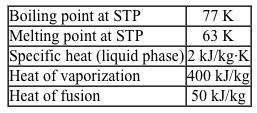
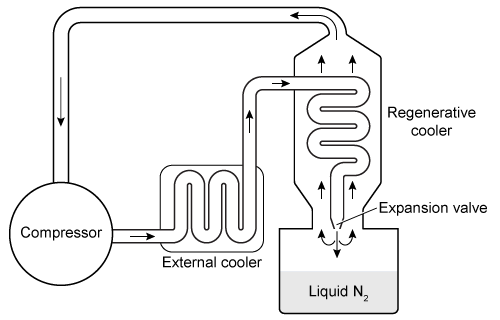 Figure 1 Hampson-Linde cycle apparatus used to liquefy nitrogenThe cycle begins by compressing nitrogen gas and forcing it through a coil in an external cooler that contains dry ice. The gas proceeds to a heat exchanger, where it cools further due to the countercurrent heat exchange with colder nitrogen gas returning from a later stage of the cycle; this process is known as regenerative cooling. The gas is subsequently forced through a narrow valve, where it expands and cools significantly upon exiting. As a result, a portion of the gas becomes liquefied.The temperature change of the gas exiting the valve is described by the Joule-Thomson effect, which occurs without heat transfer with the surroundings. Finally, the liquefied nitrogen is collected, and the remaining gas is sent through the regenerative cooler back to the compressor to reenter the cycle. The physical properties of nitrogen are given in Table 1.Table 1 Thermal Properties of Nitrogen
-Which thermodynamic quantity involved in the Hampson-Linde cycle is a state function?
A) Entropy of nitrogen, because it describes an equilibrium state of the system
B) Entropy of nitrogen, because it describes a path to an equilibrium state of the system
C) Work done by the compressor, because it describes an equilibrium state of the system
D) Work done by the compressor, because it describes a path to an equilibrium state of the system
Correct Answer:

Verified
Correct Answer:
Verified
Q20: An observer perceives a sound to be
Q21: Blood flows through a vessel in the
Q22: A charged particle is accelerated in a
Q23: Passage<br>Hydrostatic weighing is a technique used to
Q24: Passage<br>Osteoporosis is a degenerative bone condition in
Q26: Passage<br>The electric capacitance of biological tissues serves
Q27: Passage<br>Positron emission tomography (PET) is a medical
Q28: <img src="https://d2lvgg3v3hfg70.cloudfront.net/MD0008/.jpg" alt=" The table above
Q29: Passage<br>Positron emission tomography (PET) is a medical
Q30: The photoelectric effect refers to the ejection