Multiple Choice
Passage
Positron emission tomography (PET) is a medical imaging technique used for the detection of tumors and the evaluation of neurological functions. A radiopharmaceutical (radioactive tracer) injected into a patient undergoes positive beta decay and emits a positron. The positron undergoes an annihilation event with a nearby electron (<1 mm away) , which emits a pair of 511 keV gamma ray photons traveling in opposite directions. The gamma rays are detected by a ring of scintillation detectors surrounding the patient, as shown in Figure 1. The difference in detection time between the two gamma rays from the same annihilation event is used to determine its location. An image is constructed from data collected from multiple emission events.
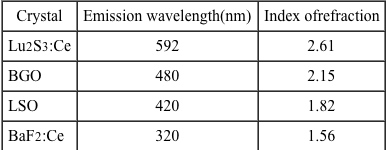
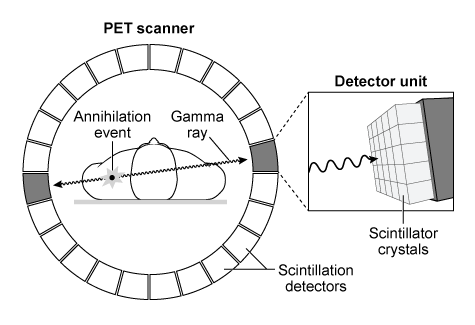 Figure 1 Basic setup and process of positron emission tomographyScintillation, the emission of detectable light when excited electrons return to their ground state, occurs in crystals within the detectors due to the transfer of energy from the high energy gamma rays. The wavelength of the emitted light depends exclusively on the type of scintillation material used (Table 1) .Table 1 Common PET Scintillating Crystal Materials
 The electrons in the scintillating crystals are excited through Compton scattering, a process in which a gamma ray photon acts as a particle, and transfers energy to an electron via collision. Subsequently, the photon scatters (travels in a new direction) and its wavelength changes. The percent change in the wavelength of the photon due to the energy loss is
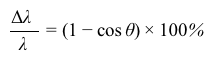 Equation 1where θ is the angle between the scattered photon and electron. Equation 1 is represented in Figure 2.
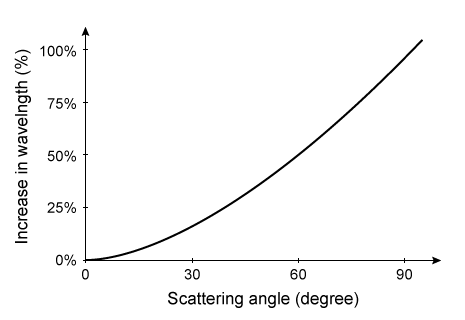 Figure 2 Percent change in photon wavelength due to Compton scattering
-In which of the given scintillation materials will light travel the slowest?
A) Lu2S3:Ce
B) BGO
C) LSO
D) BaF2:Ce
Correct Answer:

Verified
Correct Answer:
Verified
Q24: Passage<br>Osteoporosis is a degenerative bone condition in
Q25: Passage<br>Nitrogen is extremely cold in its liquid
Q26: Passage<br>The electric capacitance of biological tissues serves
Q27: Passage<br>Positron emission tomography (PET) is a medical
Q28: <img src="https://d2lvgg3v3hfg70.cloudfront.net/MD0008/.jpg" alt=" The table above
Q30: The photoelectric effect refers to the ejection
Q31: Passage<br>In the event of end-stage heart failure,
Q32: Passage<br>In the event of end-stage heart failure,
Q33: Circularly polarized light results from the vector
Q34: Uniform magnetic fields created by advanced medical