Multiple Choice
Passage
Chloramphenicol (Compound 1) is an antibiotic that acts against gram-positive and gram-negative bacteria by blocking peptidyl transfer, which inhibits protein synthesis by bacterial ribosomes. However, it tastes bitter, so most patients cannot tolerate it. As a result, synthesis of hydroxyl-substituted chloramphenicol analogues has become of interest because ester chloramphenicol analogues taste better than chloramphenicol. Substituents on the primary hydroxyl group of chloramphenicol analogues are typically hydrolyzed quickly in vivo to regenerate Compound 1. Compound 3, a chloramphenicol analogue, was synthesized by the transesterification of Compound 1 and vinyl propionate (Compound 2) , catalyzed by the enzyme LipBA lipase (Figure 1) .
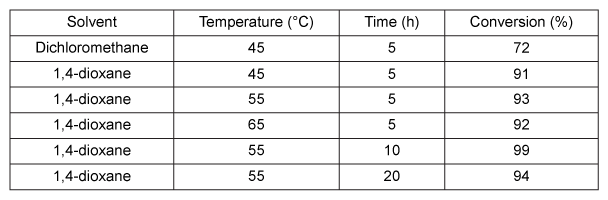
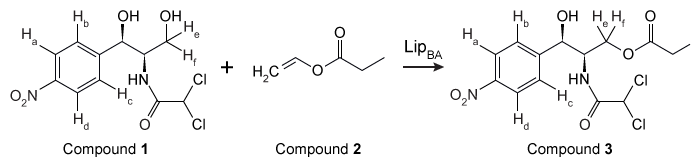 Figure 1 Transesterification of chloramphenicol catalyzed by LipBAAlthough enzyme catalysis allows for efficient regiospecific and stereospecific bond formation, the reaction conditions for the conversion efficiency of Compound 1 to Compound 3, as well as the purity of Compound 3, must also be optimized. The reaction solvent, temperature, and time were studied to find the conditions that gave the highest conversion rate and purity. Each parameter was altered individually while all others were kept constant, and the enzyme concentration was 4.5 g/L in each trial. The results of this study are shown in Table 1. The purity of Compound 3 was found to be over 90% when 1,4-dioxane was used and over 70% when dichloromethane was used.Table 1 Transesterification Conditions Optimization
 The transesterification reaction was monitored by thin-layer chromatography (Figure 2) , and the product was confirmed by 1H NMR. The 1H NMR spectra of Compounds 1 and 3 can be distinguished by the shift of He and Hf due to the addition of the electronegative ester functional group.
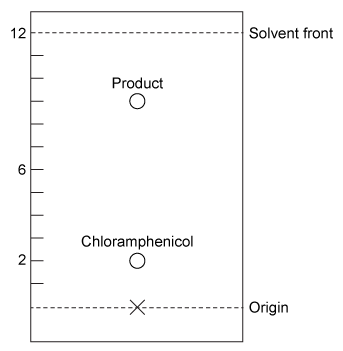 Figure 2 Thin-layer chromatography of reaction mixture
Adapted from F. Dong et al., "Transesterification Synthesis of Chloramphenicol." Molecules. ©2017 MDPI.
-Which of the following experimental conditions does NOT contribute to the highest conversion efficiency?
A) Use of 1,4-dioxane as the solvent
B) Reaction temperature of 55 °C
C) Reaction time of 20 hours
D) Enzyme concentration of 4.5 g/L
Correct Answer:

Verified
Correct Answer:
Verified
Q141: Passage<br>The β-lactam scaffold is an important feature
Q142: Passage<br>A group of students studied the reactivity
Q143: Passage<br>The β-lactam scaffold is an important feature
Q144: Passage<br>Students perform a synthesis of a carboxylic
Q145: The number of different stereoisomers that exist
Q147: Passage<br>Aldehydes are organic compounds encountered in everyday
Q148: Passage<br>The cryptophycins, isolated from cyanobacteria, are a
Q149: Passage<br>Two key ingredients found in many soaps
Q150: Passage<br>Malaria is caused by the parasite Plasmodium
Q151: During the synthesis of a tosylate, which