Multiple Choice
Passage
Two key ingredients found in many soaps are PEG 150 distearate and ethylhexyl glycerin. Both can be synthesized from glyceryl tristearate (Figure 1) .
 Figure 1 Formation of PEG 150 distearate and ethylhexyl glycerin from glyceryl tristearateThe first step in this process requires the saponification of glyceryl tristearate. The resulting stearate molecules can then react with PEG 150 in an acid-catalyzed Fischer esterification to form PEG 150 distearate. The glycerol produced during saponification is used as a nucleophile to form ethylhexyl glycerin through a base-catalyzed SN2 reaction with an ethylhexyl halide.Studies have shown that hand washing with soap can substantially reduce the number of germs present on hands and that washing hands before preparing food is particularly effective in reducing illness. Researchers examined the effect of washing for 20 seconds with different amounts of soap containing PEG 150 distearate and ethylhexyl glycerin and found an inverse correlation between the volume of soap used and the amount of bacteria recovered from the hands. The data are shown in Figure 2.
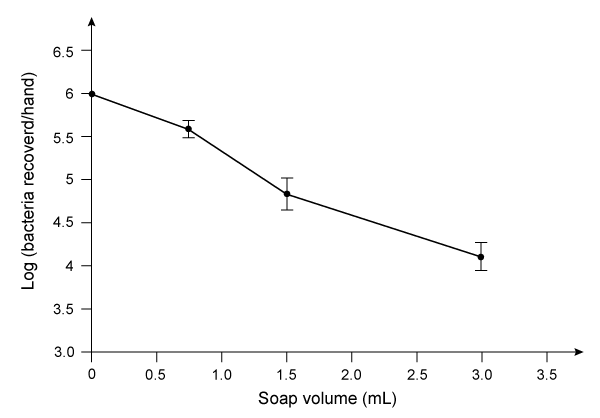 Figure 2 Bacteria recovered from hands after washing with varying amounts of soapThe researchers then investigated the effect of hand washing with different kinds of soap on the transfer of bacteria from hands to objects. Volunteers washed with a fixed volume of soap for 30 seconds, then handled sterilized plastic spheres for 30 seconds. Bacteria were then recovered from the spheres. The results are shown in Table 1.Table 1 Bacteria Recovered from Objects
 Adapted from Fuls JL, Rodgers ND, Fischler GE, et al. Alternative hand contamination technique to compare the activities of antimicrobial and nonantimicrobial soaps under different test conditions. Appl Environ Microbiol. 2008.
-Counting the number of bacteria recovered from which of the following would NOT help researchers verify that soap reduces the number of bacteria transferred to objects?
A) Unwashed hands directly
B) Spheres after washing hands with water only
C) Untouched spheres
D) Spheres touched with unwashed hands
Correct Answer:

Verified
Correct Answer:
Verified
Q144: Passage<br>Students perform a synthesis of a carboxylic
Q145: The number of different stereoisomers that exist
Q146: Passage<br>Chloramphenicol (Compound <strong>1</strong>) is an antibiotic that
Q147: Passage<br>Aldehydes are organic compounds encountered in everyday
Q148: Passage<br>The cryptophycins, isolated from cyanobacteria, are a
Q150: Passage<br>Malaria is caused by the parasite Plasmodium
Q151: During the synthesis of a tosylate, which
Q152: A 100-mL aqueous HCl solution was made
Q153: Passage<br>A group of students studied the reactivity
Q154: The compound shown below has selected carbons