Multiple Choice
Passage
Chloramphenicol (Compound 1) is an antibiotic that acts against gram-positive and gram-negative bacteria by blocking peptidyl transfer, which inhibits protein synthesis by bacterial ribosomes. However, it tastes bitter, so most patients cannot tolerate it. As a result, synthesis of hydroxyl-substituted chloramphenicol analogues has become of interest because ester chloramphenicol analogues taste better than chloramphenicol. Substituents on the primary hydroxyl group of chloramphenicol analogues are typically hydrolyzed quickly in vivo to regenerate Compound 1. Compound 3, a chloramphenicol analogue, was synthesized by the transesterification of Compound 1 and vinyl propionate (Compound 2) , catalyzed by the enzyme LipBA lipase (Figure 1) .
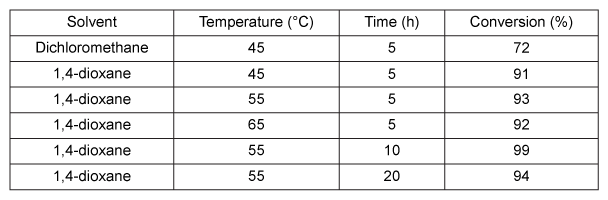
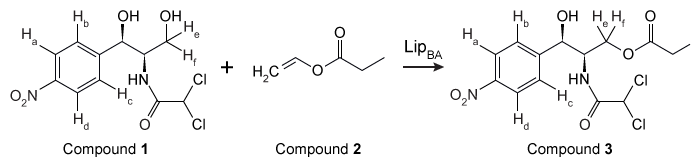 Figure 1 Transesterification of chloramphenicol catalyzed by LipBAAlthough enzyme catalysis allows for efficient regiospecific and stereospecific bond formation, the reaction conditions for the conversion efficiency of Compound 1 to Compound 3, as well as the purity of Compound 3, must also be optimized. The reaction solvent, temperature, and time were studied to find the conditions that gave the highest conversion rate and purity. Each parameter was altered individually while all others were kept constant, and the enzyme concentration was 4.5 g/L in each trial. The results of this study are shown in Table 1. The purity of Compound 3 was found to be over 90% when 1,4-dioxane was used and over 70% when dichloromethane was used.Table 1 Transesterification Conditions Optimization
 The transesterification reaction was monitored by thin-layer chromatography (Figure 2) , and the product was confirmed by 1H NMR. The 1H NMR spectra of Compounds 1 and 3 can be distinguished by the shift of He and Hf due to the addition of the electronegative ester functional group.
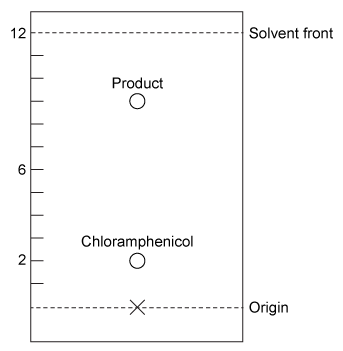 Figure 2 Thin-layer chromatography of reaction mixture
Adapted from F. Dong et al., "Transesterification Synthesis of Chloramphenicol." Molecules. ©2017 MDPI.
-Based on the structure of Compound 1 provided in Figure 1, which stretch gives a narrow absorption of weak intensity at approximately 3100 cm−1 in the infrared spectrum?
A) The C=C stretch
B) The C=O stretch
C) The C-Ha stretch
D) The C-He stretch
Correct Answer:

Verified
Correct Answer:
Verified
Q173: Passage<br>Two key ingredients found in many soaps
Q174: Suppose that a 0.2 g/mL solution of
Q175: Passage<br>The β-lactam scaffold is an important feature
Q176: Which term can be used to classify
Q177: Passage<br>Fluorescent amino acids are useful for labeling
Q179: Compound <strong>1</strong> is shown below. <img src="https://d2lvgg3v3hfg70.cloudfront.net/MD0008/.jpg"
Q180: A solution of Compound 1, shown below,
Q181: What structure is equivalent to Compound 1
Q182: The solutes in an aqueous reaction mixture
Q183: Passage<br>The protozoan Euglena gracilis expresses glycosyltransferases (enzymes