Multiple Choice
Passage
Two key ingredients found in many soaps are PEG 150 distearate and ethylhexyl glycerin. Both can be synthesized from glyceryl tristearate (Figure 1) .
 Figure 1 Formation of PEG 150 distearate and ethylhexyl glycerin from glyceryl tristearateThe first step in this process requires the saponification of glyceryl tristearate. The resulting stearate molecules can then react with PEG 150 in an acid-catalyzed Fischer esterification to form PEG 150 distearate. The glycerol produced during saponification is used as a nucleophile to form ethylhexyl glycerin through a base-catalyzed SN2 reaction with an ethylhexyl halide.Studies have shown that hand washing with soap can substantially reduce the number of germs present on hands and that washing hands before preparing food is particularly effective in reducing illness. Researchers examined the effect of washing for 20 seconds with different amounts of soap containing PEG 150 distearate and ethylhexyl glycerin and found an inverse correlation between the volume of soap used and the amount of bacteria recovered from the hands. The data are shown in Figure 2.
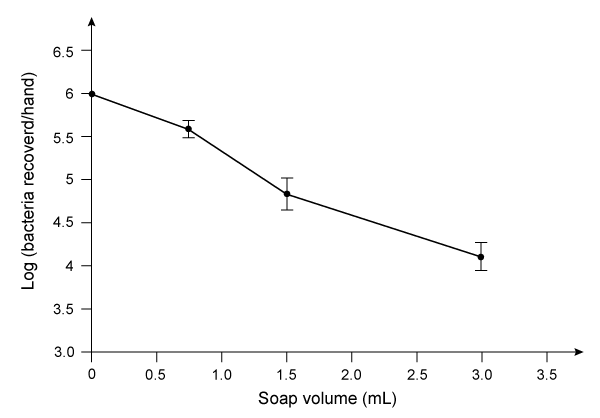 Figure 2 Bacteria recovered from hands after washing with varying amounts of soapThe researchers then investigated the effect of hand washing with different kinds of soap on the transfer of bacteria from hands to objects. Volunteers washed with a fixed volume of soap for 30 seconds, then handled sterilized plastic spheres for 30 seconds. Bacteria were then recovered from the spheres. The results are shown in Table 1.Table 1 Bacteria Recovered from Objects
 Adapted from Fuls JL, Rodgers ND, Fischler GE, et al. Alternative hand contamination technique to compare the activities of antimicrobial and nonantimicrobial soaps under different test conditions. Appl Environ Microbiol. 2008.
-Why does the bond between glycerol and the ethylhexyl group tend to form at glycerol's C1 hydroxyl group instead of the C2 hydroxyl group?
A) Secondary alcohols are more likely to undergo SN1 reactions than primary alcohols.
B) Secondary alcohols are more sterically hindered than primary alcohols.
C) Primary alcohols are less acidic than secondary alcohols.
D) Primary alcohols are more electrophilic than secondary alcohols.
Correct Answer:

Verified
Correct Answer:
Verified
Q168: Passage<br>The protozoan Euglena gracilis expresses glycosyltransferases (enzymes
Q169: Which of the following characterize gas-liquid chromatography?Gas
Q170: Passage<br>Electrospray ionization mass spectrometry (ESI-MS) employs a
Q171: <img src="https://d2lvgg3v3hfg70.cloudfront.net/MD0008/.jpg" alt=" The above chromatogram
Q172: Two separate reactions are conducted in which
Q174: Suppose that a 0.2 g/mL solution of
Q175: Passage<br>The β-lactam scaffold is an important feature
Q176: Which term can be used to classify
Q177: Passage<br>Fluorescent amino acids are useful for labeling
Q178: Passage<br>Chloramphenicol (Compound <strong>1</strong>) is an antibiotic that