Multiple Choice
Passage
Students used three classification tests to study the reactivity of alcohol, aldehyde, and ketone functional groups in organic compounds. The organic compounds provided to the students are given in Table 1.Table 1 Organic Compounds Tested
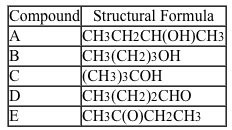 First, the students performed the Lucas test by mixing a few drops of each compound with 2 mL of the Lucas reagent (ZnCl2 and HCl) . This reagent is used to test for secondary and tertiary alcohols. A positive test result is indicated by a cloudy reaction mixture upon addition of the Lucas reagent due to the formation of an insoluble compound by an SN1 reaction with a secondary or tertiary alcohol (Reaction 1) .
 Reaction 1Next, a test for alcohols and aldehydes was performed by the addition of a drop of chromic acid reagent (CrO3 dissolved in aqueous H2SO4) into samples of the organic compounds. The disappearance of the orange color from chromic acid and formation of a blue-green suspension is indicative of a positive result for this test. Compound A was found to be an example of a positive result, as shown in Reaction 2.
 Reaction 2Finally, samples of the compounds were also dissolved in water, followed by the addition of NaOH and iodine. This test is known as the iodoform test, which is used to identify methyl ketones and secondary alcohols. A positive result is indicated by the formation of iodoform (CHI3) , a yellow precipitate (Reaction 3) .
 3Table 2 Selected Observations from the Classification Tests
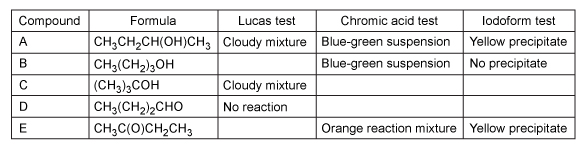
-Compound D gives a positive result for the chromic acid test. What is the structure of the product formed by the reaction of Compound D with the chromic acid reagent?
A) 
B) 
C) 
D) 
Correct Answer:

Verified
Correct Answer:
Verified
Q130: Passage<br>Solid-phase peptide synthesis is normally carried out
Q131: Passage<br>Fluorescent amino acids are useful for labeling
Q132: Passage<br>Hemophilia B is a blood clotting disorder
Q133: Passage<br>Electrospray ionization mass spectrometry (ESI-MS) employs a
Q134: Passage<br>Two key ingredients found in many soaps
Q136: The infrared spectrum shows the frequencies of
Q137: What types of functional groups react to
Q138: Passage<br>Aldehydes are organic compounds encountered in everyday
Q139: Passage<br>The drug paracetamol, also known as acetaminophen,
Q140: Researchers want to synthesize valine from isovaleric