Multiple Choice
Passage
Fluorescent amino acids are useful for labeling proteins because they can be visualized spectroscopically, facilitating the study of protein structure and interactions. The noncanonical amino acid dansylalanine, a fluorescent amino acid that is sensitive to the hydrophobicity of its environment, is a good candidate to be incorporated into proteins because of its small size and fluorescent capabilities. Dansyl chloride and Compound 1 were used to synthesize dansylalanine, as shown in Reaction 1. Dansylalanine absorbs maximally at 340 nm and emits at approximately 540 nm.
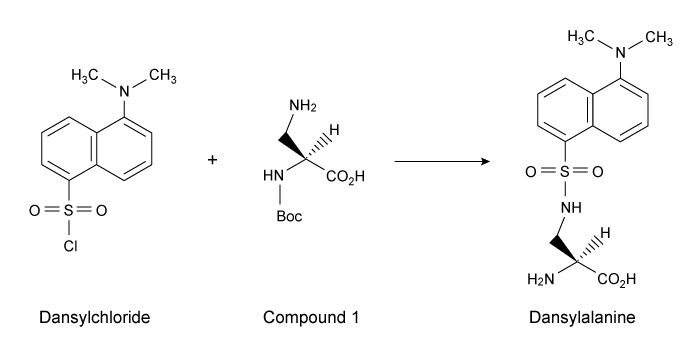 Reaction 1 Synthesis of dansylalanineA leucyl-tRNA synthetase from Escherichia coli was engineered to aminoacylate bacterial tRNAs containing a CUA anticodon with dansylalanine. After verifying that the tRNA/synthetase pair does not interact with endogenous amino acids or tRNAs, it was transfected into the yeast Saccharomyces cerevisiae along with a plasmid encoding a mutated human superoxide dismutase (hSOD) . Using this system, dansylalanine was genetically incorporated into hSOD in place of either Gln-16 or Trp-33, and expressed in S. cerevisiae.Position 16 is located on the surface of hSOD at the N-terminus of a β-strand, and position 33 lies in the center of a strand within a β-barrel. To probe changes in the structure of hSOD, researchers exposed the purified protein to guanidinium chloride (GdmCl) to denature the protein at concentrations ranging 0-4.5 M. The experiment was conducted in a 35 mM sodium phosphate buffer at pH 7.2. The fluorescence of hSOD with dansylalanine at either position 16 or 33 was monitored at each GdmCl concentration, and the results of the unfolding experiment are shown in Figure 1.
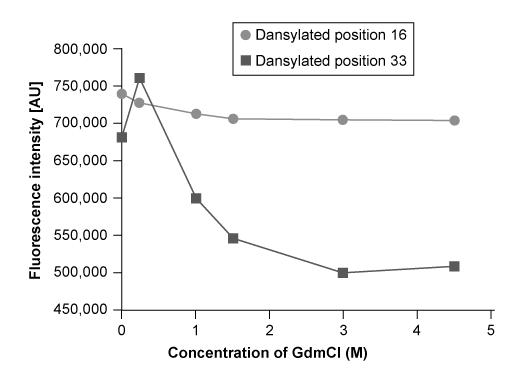 Figure 1 Plot of dansylalanine fluorescence at different concentrations of GdmCl
Adapted from Summerer D, Chen S, Wu N, Deiters A, Chin JW, Schultz PG. A genetically encoded fluorescent amino acid. Proc Natl Acad Sci USA. 2006.
-In the synthesis of dansylalanine, the Boc group on Compound 1 most likely functions to:
A) protect the α-amino group from nucleophilic reaction.
B) protect the C-terminus from nucleophilic reaction.
C) make the N-terminus a better leaving group.
D) make the carboxyl a better leaving group.
Correct Answer:

Verified
Correct Answer:
Verified
Q126: Passage<br>The protozoan Euglena gracilis expresses glycosyltransferases (enzymes
Q127: Passage<br>The drug paracetamol, also known as acetaminophen,
Q128: Passage<br>The protozoan Euglena gracilis expresses glycosyltransferases (enzymes
Q129: Passage<br>Fatty acids (FAs) are lipids that play
Q130: Passage<br>Solid-phase peptide synthesis is normally carried out
Q132: Passage<br>Hemophilia B is a blood clotting disorder
Q133: Passage<br>Electrospray ionization mass spectrometry (ESI-MS) employs a
Q134: Passage<br>Two key ingredients found in many soaps
Q135: Passage<br>Students used three classification tests to study
Q136: The infrared spectrum shows the frequencies of