Multiple Choice
Passage
Ethanol is an important source of energy that is frequently used as a supplement to gasoline. It can be obtained from renewable resources such as the cellulose found in plant matter. When subjected to a process called gasification, the plant mass is converted to a mixture called syngas, composed predominantly of carbon monoxide and molecular hydrogen. Syngas can be passed over a rhodium catalyst to generate ethanol and other products. After using this method, a group of researchers analyzed the resulting products by gas chromatography using helium as a carrier gas. The results are shown in Figure 1.
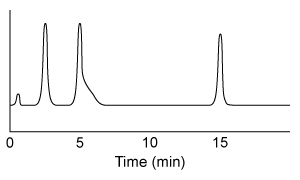 Figure 1 Gas chromatograph of syngas catalysis productsMass spectrometry revealed that the process yielded similar amounts of ethanol, acetic acid, and acetaldehyde, with trace amounts of ethane. In addition, the ethanol peak was found to be contaminated with ethyl acetate. Another group of researchers in the same laboratory had recently produced Compound 1 as a by-product in a separate reaction. They combined Compound 1 with purified ethyl acetate to form megestrol acetate, a drug used in the treatment of certain cancers. This reaction also produced ethanol, as shown in Scheme 1.
 Scheme 1
Adapted from Lopez L, Velasco J, Montes V, Marinas A, Cabrera S, Boutonnet M, Järås S. Catalysts 2015.
-Acetic acid most likely eluted from the gas chromatograph at what time point?
A) 1 min
B) 2 min
C) 5 min
D) 15 min
Correct Answer:

Verified
Correct Answer:
Verified
Q108: Passage<br>A limited number of cellular functions exist
Q109: Passage<br>The β-lactam scaffold is an important feature
Q110: Passage<br>A group of students studied the reactivity
Q111: Passage<br>Ethanol is an important source of energy
Q112: Passage<br>Solid-phase peptide synthesis is normally carried out
Q114: The amino acid serine is shown below.
Q115: Passage<br>Two key ingredients found in many soaps
Q116: Passage<br>Two key ingredients found in many soaps
Q117: Passage<br>Students used three classification tests to study
Q118: Passage<br>Electrospray ionization mass spectrometry (ESI-MS) employs a