Multiple Choice
Passage
Students used three classification tests to study the reactivity of alcohol, aldehyde, and ketone functional groups in organic compounds. The organic compounds provided to the students are given in Table 1.Table 1 Organic Compounds Tested
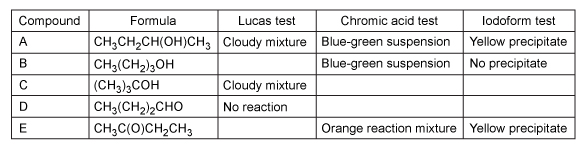
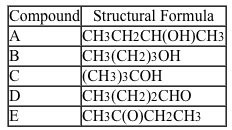 First, the students performed the Lucas test by mixing a few drops of each compound with 2 mL of the Lucas reagent (ZnCl2 and HCl) . This reagent is used to test for secondary and tertiary alcohols. A positive test result is indicated by a cloudy reaction mixture upon addition of the Lucas reagent due to the formation of an insoluble compound by an SN1 reaction with a secondary or tertiary alcohol (Reaction 1) .
 Reaction 1Next, a test for alcohols and aldehydes was performed by the addition of a drop of chromic acid reagent (CrO3 dissolved in aqueous H2SO4) into samples of the organic compounds. The disappearance of the orange color from chromic acid and formation of a blue-green suspension is indicative of a positive result for this test. Compound A was found to be an example of a positive result, as shown in Reaction 2.
 Reaction 2Finally, samples of the compounds were also dissolved in water, followed by the addition of NaOH and iodine. This test is known as the iodoform test, which is used to identify methyl ketones and secondary alcohols. A positive result is indicated by the formation of iodoform (CHI3) , a yellow precipitate (Reaction 3) .
 3Table 2 Selected Observations from the Classification Tests
-An unknown compound containing both a secondary alcohol and an aldehyde in its structure was given to a student. Suppose the Lucas test confirmed there was an alcohol present. If a protecting group were added to the alcohol, would a positive result from the chromic acid test be indicative of only the presence of the aldehyde?
A) Yes, because an aldehyde is unreactive under oxidizing conditions
B) No, because an aldehyde is reactive under oxidizing conditions
C) Yes, because a protected alcohol group is unreactive under oxidizing conditions
D) No, because a protected alcohol group is reactive under oxidizing conditions
Correct Answer:

Verified
Correct Answer:
Verified
Q112: Passage<br>Solid-phase peptide synthesis is normally carried out
Q113: Passage<br>Ethanol is an important source of energy
Q114: The amino acid serine is shown below.
Q115: Passage<br>Two key ingredients found in many soaps
Q116: Passage<br>Two key ingredients found in many soaps
Q118: Passage<br>Electrospray ionization mass spectrometry (ESI-MS) employs a
Q119: If a primary alkyl halide and a
Q120: Passage<br>A group of students studied the reactivity
Q121: When the compound shown below undergoes an
Q122: Passage<br>Malaria is caused by the parasite Plasmodium