Solved

Passage A Group of Students Studied the Reactivity of Four Alkyl

Question 110

Multiple Choice

Passage
A group of students studied the reactivity of four alkyl halides (R−X) in two nucleophilic substitution reactions.  Nucleophilic substitution reactions can go through one of two mechanisms.  The SN2 reaction requires substitution of a leaving group with a nucleophile in a single step (Reaction 1) , and the SN1 reaction requires elimination of the leaving group and formation of an intermediate before nucleophilic substitution can occur, resulting in a two-step process (Reaction 2) .R−X + NaI → R−I + NaX↓Reaction 1R−X + AgNO3 → R+ + AgX↓ + HOCH2CH3 → R−OCH2CH3 + HNO3Reaction 2Experiment 1The students performed the SN2 reaction (Reaction 1) by the addition of a few drops of each alkyl halide into a separate test tube containing 1 mL of 15% solution of NaI in acetone at 25°C.  After mixing, they monitored the reaction for the formation of a precipitate (sodium halide salt) .  If no precipitate formed after 5 minutes, they raised the temperature of the reaction to 50°C and again checked for the formation of a precipitate.  Formation of a precipitate indicated the substrate underwent nucleophilic substitution.  The results observed for the Finkelstein reaction are shown in Table 1.Table 1  Results of the SN2 Reaction
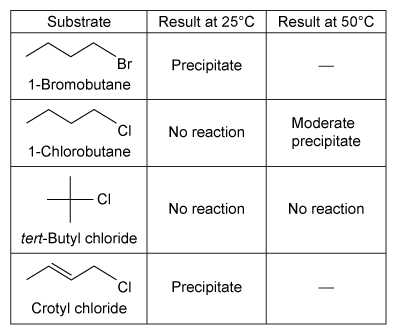
Passage A group of students studied the reactivity of four alkyl halides (R−X)  in two nucleophilic substitution reactions.  Nucleophilic substitution reactions can go through one of two mechanisms.  The S<sub>N</sub>2 reaction requires substitution of a leaving group with a nucleophile in a single step (Reaction 1) , and the S<sub>N</sub>1 reaction requires elimination of the leaving group and formation of an intermediate before nucleophilic substitution can occur, resulting in a two-step process (Reaction 2) .R−X + NaI → R−I + NaX↓<strong>Reaction 1</strong>R−X + AgNO<sub>3</sub> → R<sup>+</sup> + AgX↓ + HOCH<sub>2</sub>CH<sub>3</sub> → R−OCH<sub>2</sub>CH<sub>3</sub> + HNO<sub>3</sub><strong>Reaction 2</strong>Experiment 1The students performed the S<sub>N</sub>2 reaction (Reaction 1)  by the addition of a few drops of each alkyl halide into a separate test tube containing 1 mL of 15% solution of NaI in acetone at 25°C.  After mixing, they monitored the reaction for the formation of a precipitate (sodium halide salt) .  If no precipitate formed after 5 minutes, they raised the temperature of the reaction to 50°C and again checked for the formation of a precipitate.  Formation of a precipitate indicated the substrate underwent nucleophilic substitution.  The results observed for the Finkelstein reaction are shown in Table 1.<strong>Table 1</strong>  Results of the S<sub>N</sub>2 Reaction    Experiment 2The students repeated the procedure followed in Experiment 1 except they added a few drops of each alkyl halide into a separate test tube containing 1 mL of 1% solution of AgNO<sub>3</sub> in ethanol at 25°C.  The results observed for this reaction are shown in Table 2.<strong>Table 2</strong>  Results of the S<sub>N</sub>1 Reaction    -The substrate tert-butylchloride reacts in Experiment 2 but not in Experiment 1 because:the leaving group is bonded to a primary carbon.a stable carbocation forms in Experiment 2.the leaving group is bonded to a tertiary carbon.an unstable carbocation forms in Experiment 2. A) I and II only B) I and IV only C) II and III only D) III and IV only Experiment 2The students repeated the procedure followed in Experiment 1 except they added a few drops of each alkyl halide into a separate test tube containing 1 mL of 1% solution of AgNO3 in ethanol at 25°C.  The results observed for this reaction are shown in Table 2.Table 2  Results of the SN1 Reaction
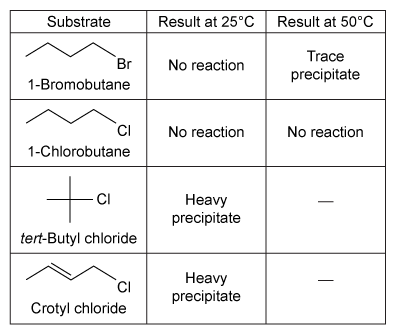
Passage A group of students studied the reactivity of four alkyl halides (R−X)  in two nucleophilic substitution reactions.  Nucleophilic substitution reactions can go through one of two mechanisms.  The S<sub>N</sub>2 reaction requires substitution of a leaving group with a nucleophile in a single step (Reaction 1) , and the S<sub>N</sub>1 reaction requires elimination of the leaving group and formation of an intermediate before nucleophilic substitution can occur, resulting in a two-step process (Reaction 2) .R−X + NaI → R−I + NaX↓<strong>Reaction 1</strong>R−X + AgNO<sub>3</sub> → R<sup>+</sup> + AgX↓ + HOCH<sub>2</sub>CH<sub>3</sub> → R−OCH<sub>2</sub>CH<sub>3</sub> + HNO<sub>3</sub><strong>Reaction 2</strong>Experiment 1The students performed the S<sub>N</sub>2 reaction (Reaction 1)  by the addition of a few drops of each alkyl halide into a separate test tube containing 1 mL of 15% solution of NaI in acetone at 25°C.  After mixing, they monitored the reaction for the formation of a precipitate (sodium halide salt) .  If no precipitate formed after 5 minutes, they raised the temperature of the reaction to 50°C and again checked for the formation of a precipitate.  Formation of a precipitate indicated the substrate underwent nucleophilic substitution.  The results observed for the Finkelstein reaction are shown in Table 1.<strong>Table 1</strong>  Results of the S<sub>N</sub>2 Reaction    Experiment 2The students repeated the procedure followed in Experiment 1 except they added a few drops of each alkyl halide into a separate test tube containing 1 mL of 1% solution of AgNO<sub>3</sub> in ethanol at 25°C.  The results observed for this reaction are shown in Table 2.<strong>Table 2</strong>  Results of the S<sub>N</sub>1 Reaction    -The substrate tert-butylchloride reacts in Experiment 2 but not in Experiment 1 because:the leaving group is bonded to a primary carbon.a stable carbocation forms in Experiment 2.the leaving group is bonded to a tertiary carbon.an unstable carbocation forms in Experiment 2. A) I and II only B) I and IV only C) II and III only D) III and IV only
-The substrate tert-butylchloride reacts in Experiment 2 but not in Experiment 1 because:the leaving group is bonded to a primary carbon.a stable carbocation forms in Experiment 2.the leaving group is bonded to a tertiary carbon.an unstable carbocation forms in Experiment 2.


A) I and II only
B) I and IV only
C) II and III only
D) III and IV only

Correct Answer:

verifed

Verified

Unlock this answer now
Get Access to more Verified Answers free of charge

Related Questions