Multiple Choice
Passage
Amino acids and copper both serve vital roles in many biological processes of living organisms. Beyond their separate biological roles, however, chemists have also discovered that amino acids are able to function as chelates with Cu2+ ions to form blue complexes with potential medicinal applications. One such complex, copper(II) glycinate, has shown to be effective against some oral diseases. The reaction to form copper(II) glycinate is shown in Figure 1.
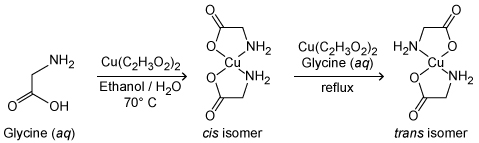 Figure 1 Synthesis of two isomers of copper(II) glycinateTwo different isomers can form depending on the reaction conditions. Mixing hot aqueous glycine (70 °C) with a hot solution of copper(II) acetate dissolved in 50% aqueous ethanol, followed by cooling the mixture on ice, yields a precipitate of only the cis isomer. If a suspension of the cis isomer is held at boiling for an hour or longer in a solution of glycine and copper(II) acetate, the trans isomer is obtained.Because of the geometric differences between the two isomers, the stretching vibrations of the central Cu-N and Cu-O bonds in each isomer are different. Symmetric and asymmetric bond stretching give four possible vibrational modes for each isomer, as shown in Figure 2.
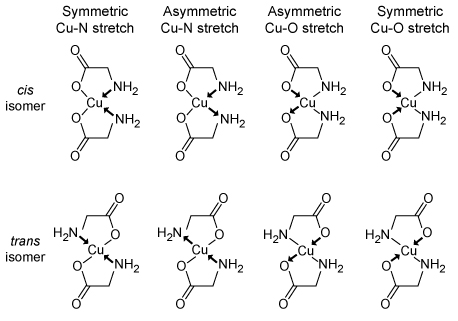 Figure 2 Vibrational modes of the coordinate bonds in copper(II) glycinateIf the stretching of the bonds during vibration causes a transient, unequal distribution of electron density between the atoms within the bond, an oscillating dipole will form. Bonds with dipoles that are not cancelled out by another dipole in the molecule will absorb infrared light at particular frequencies (often expressed in wave numbers) and are designated as IR-active. As a result, the vibrational differences between the two isomers can be analyzed by far-infrared (far-IR) spectroscopy, as shown in Figure 3.
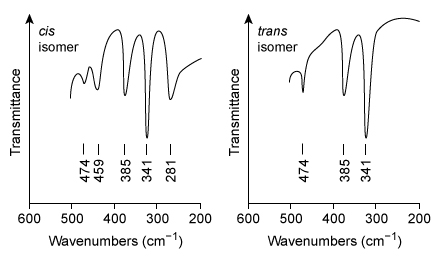 Figure 3 Far-IR spectra of the cis and trans isomers of copper(II) glycinateBoth isomers show a skeletal absorbance (unrelated to coordinate bond vibration) near 385 cm−1. Additional absorbance bands are seen that specifically relate to the vibrational modes of the bonds in each isomer.
-How many vibrational modes of the coordinate bonds from each isomer of copper(II) glycinate are observable by far-IR spectroscopic analysis? (Note: Exclude skeletal vibrational modes unrelated to the coordinate bonds.)
A) Four modes in both the trans isomer and the cis isomer
B) Two modes in the trans isomer and 4 modes in the cis isomer
C) Four modes in the trans isomer and 2 modes in the cis isomer
D) Three modes in the trans isomer and 5 modes in the cis isomer
Correct Answer:

Verified
Correct Answer:
Verified
Q259: Passage<br>Catabolism is an oxidative process in which
Q260: The equilibrium <img src="https://d2lvgg3v3hfg70.cloudfront.net/MD0008/.jpg" alt="The equilibrium
Q261: Passage<br>Nuclear medicine uses radiopharmaceuticals for disease treatment
Q262: Fructose 6-phosphate (Fru-6-P) breaks down in water
Q263: Passage<br>Catabolism is an oxidative process in which
Q265: Liquid nitrogen is used in cryosurgery for
Q266: Passage<br>Sulfur is the 10th most abundant element
Q267: Passage<br>Students were asked to bring items from
Q268: Passage<br>Combustion occurs when an oxidation-reduction reaction takes
Q269: Passage<br>Magnetic resonance imaging (MRI) interprets the nuclear