Multiple Choice
Passage
Magnetic resonance imaging (MRI) interprets the nuclear relaxation or relaxivity of hydrogen nuclei in resident water molecules. Hydrogen nuclei in water have two magnetic spin states: alpha and beta. In the presence of an applied magnetic field, these spins will align with the field in an "excited" state and then relax back to the "ground" state, producing a signal with intensity proportional to relaxivity. Frequently, an MRI contrast agent is used to increase the relaxation time in coordinated molecules, resulting in a more intense signal.Commonly used contrast agents include gadolinium-based agents. Depending on its environment, gadolinium (Gd) can have eight or nine sites in its coordination sphere, allowing Gd3+ to interact with eight water molecules as in Gd(H2O) 83+. The electronic configuration of gadolinium is shown in Figure 1.
 Figure 1 Electronic configuration of gadoliniumGd3+ alone is toxic to cells because its ionic radius is similar to that of Ca2+, allowing Gd3+ to displace Ca2+ in biologically important settings. Therefore, Gd3+ must be coordinated to an organic ligand such as 1,4,7,10-tetraazacyclododecane-1,4,7,10-tetraacetic acid (DOTA) to allow it to pass through the body safely. When chelated, DOTA displaces the water around gadolinium and leaves only one coordination site for a water molecule (Figure 2) .
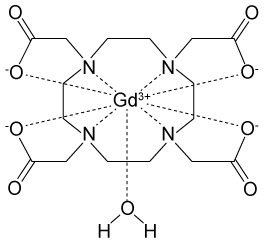 Figure 2 Gd-DOTA with a water coordinated to Gd3+Zinc ions (Zn2+) are required to store insulin and are co-released when insulin is secreted by the pancreas. To detect zinc ions in the body, researchers have designed a variation of Gd-DOTA called Gd-daa3 with two diaminoacetate (daa) arms that preferentially bind to Zn2+ ions (Figure 3) . When Zn2+ is absent, these arms coordinate to Gd3+ and create a nine-coordinate complex that prohibits water from binding to Gd3+. Binding of diaminoacetate arms to Zn2+ frees Gd3+ to coordinate with water molecules. This configuration results in increased signal intensity in the parts of the cell where Zn2+ is located.
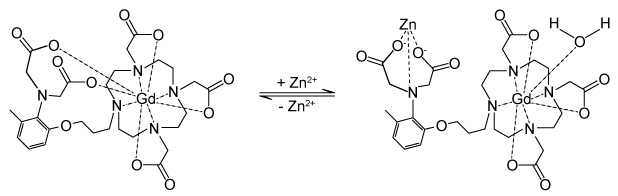 Figure 3 Gd-daa3 when Zn2+ is present
Adapted from Louie A. MRI biosensors: a short primer. J Magn Reson Imaging. 2013;38(3) :530-9.
-Which of the following accurately describes the magnetic properties of Gd3+ ions?
A) Gd3+ is diamagnetic because of unpaired electrons.
B) Gd3+ is paramagnetic and its electron spins align parallel to the applied magnetic field.
C) Gd3+ is diamagnetic because ions are attracted to the magnetic field due to their positive charge.
D) Gd3+ is paramagnetic and therefore repels magnetic field lines.
Correct Answer:

Verified
Correct Answer:
Verified
Q264: Passage<br>Amino acids and copper both serve vital
Q265: Liquid nitrogen is used in cryosurgery for
Q266: Passage<br>Sulfur is the 10th most abundant element
Q267: Passage<br>Students were asked to bring items from
Q268: Passage<br>Combustion occurs when an oxidation-reduction reaction takes
Q270: Passage<br>Although acetylsalicylic acid (aspirin) is a well-known
Q271: Which of the following molecular geometries could
Q272: Passage<br>Umami is one of five basic tastes
Q273: What are the products of the alpha
Q274: If a naturally occurring sample of an