Passage Combustion Occurs When an Oxidation-Reduction Reaction Takes Place Between a a Reduced
Multiple Choice
Passage
Combustion occurs when an oxidation-reduction reaction takes place between a reduced fuel source and an oxidizer, most frequently oxygen. The reaction between hydrogen and oxygen forms water (Reaction 1) and is highly exothermic and thermodynamically favorable. At the completion of hydrogen combustion, essentially all H2 molecules have been converted to water. Nevertheless, at room temperature and atmospheric pressure, molecular hydrogen and oxygen can coexist quite stably.2 H2 + O2 → 2 H2OReaction 1A group of researchers designed two prototype internal combustion engines, each of which could inject a hydrogen/oxygen mixture into a 5-mL combustion chamber at a total pressure of 1 atm and could repeat this process for several cycles. In one engine design, a spark was generated to initiate combustion as hydrogen and oxygen were injected. In another method, the combustion chamber was coated with a small amount of platinum powder. Platinum dramatically increases the reaction rate at room temperature without the need for a spark. The platinum itself is not altered by the reaction and can be reused. Researchers measured the maximum power output of both engine designs under identical injection and temperature conditions (Figure 1) .
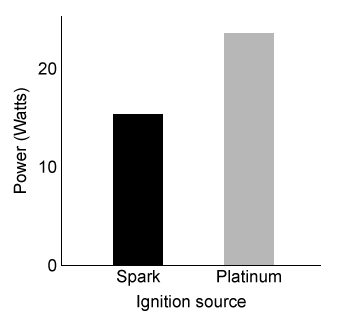 Figure 1 Relative power outputs of hydrogen engines with different ignition sources at 298 KThe power output of an engine is directly related to the rate of combustion. In the presence of platinum, researchers measured the engine's rate of water production at various temperatures and H2/O2 mixture compositions. The results are shown in Figure 2.
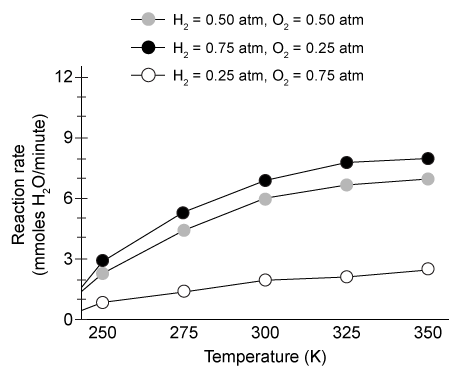 Figure 2 Rate of combustion in platinum-coated engines under various conditions
Adapted from Schultze M, Mantzaras J. Hetero-/homogeneous combustion of hydrogen/air mixtures over platinum: Fuel-lean versus fuel-rich combustion modes doi: 10.1016/j.ijhydene.2013.06.069
-When the platinum-based engine is run continuously at 300 K for 1 hour with 0.5 atm of H2 and 0.5 atm of O2 injected for each reaction, approximately what mass of water will be produced?
A) 0.36 g
B) 6.5 g
C) 360 g
D) 6,500 g
Correct Answer:

Verified
Correct Answer:
Verified
Q263: Passage<br>Catabolism is an oxidative process in which
Q264: Passage<br>Amino acids and copper both serve vital
Q265: Liquid nitrogen is used in cryosurgery for
Q266: Passage<br>Sulfur is the 10th most abundant element
Q267: Passage<br>Students were asked to bring items from
Q269: Passage<br>Magnetic resonance imaging (MRI) interprets the nuclear
Q270: Passage<br>Although acetylsalicylic acid (aspirin) is a well-known
Q271: Which of the following molecular geometries could
Q272: Passage<br>Umami is one of five basic tastes
Q273: What are the products of the alpha