Multiple Choice
Passage
Within the Actinopterygii (bony fish) lineage, marine teleosts (bony fish with mobile jaws) live in an aquatic environment where there is a higher external concentration of salt and a lower concentration of water relative to the internal concentrations. Owing to these conditions, salt ions tend to diffuse into the teleost through its skin, whereas water molecules within the organism osmotically traverse the opposite path.Irrespective of lineage, many fish species actively assess their environment and regulate their internal concentration of fluids and electrolytes via a homeostatic process known as osmoregulation. Teleosts with either glomerular kidneys (eg, eels, sculpin) or aglomerular kidneys that are purely tubular (eg, goosefish, toadfish) have served as experimental subjects for the study of marine teleost osmoregulation. Analyzing the ionic (ie, Na+, Cl−, Mg2+, SO42−) concentration of intestinal fluids, urine, and plasma in each species led to the discovery that the renal tubule of the goosefish has both excretory and reabsorptive functions.Scientists have concluded that marine teleost osmoregulation involves the ingestion of seawater, retrieval of NaCl and water from the intestine, and primary excretion of divalent ions via urine and monovalent ions through the gills (thin barriers between the organism's blood and the aquatic environment) .In an experiment to further study osmoregulatory mechanisms, researchers emptied the gut of an eel and sealed the anus to prevent fluid loss. The eel was transported into seawater that had been treated with the volume marker phenol red. After 20 hours, the eel's gut contained 2.3 mL of fluid but showed a phenol red concentration equivalent to 12.3 mL of ingested seawater. Researchers found that the eel lost 2.3 g of weight due to urine output. They ultimately reported that the eel had lost all the seawater it absorbed through the gut via various mechanisms.
-Researchers studying marine teleosts claim that the glomerular kidney is 500 times as efficient as the aglomerular kidney in eliminating nontoxic substances. Similar amounts of nontoxic ferrocyanide are intramuscularly injected into a sculpin and a goosefish of comparable weight. Given this, which of the following tables showing renal elimination of ferrocyanide after 5 hours would support the researchers' claim?
A) 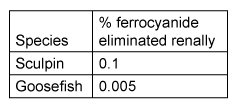
B) 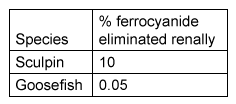
C) 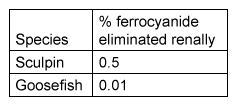
D) 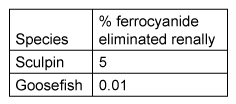
Correct Answer:

Verified
Correct Answer:
Verified
Q99: Passage<br>Parathyroid hormone (PTH) is an important regulator
Q100: Passage<br>Osteoarthritis (OA) is a disorder marked by
Q101: Which of the following cell-cell junctions would
Q102: Passage<br>Proteins known as cancer/testis antigens (CTAs) are
Q103: Passage<br>Obesity is a condition that affects over
Q105: Passage<br>Lipopolysaccharides (LPS) found in gram-negative bacterial cells
Q106: Passage<br>Renal reabsorption of glucose is facilitated by
Q107: Which step(s) of the viral life cycle
Q108: Camels inhabit water-deficient environments and exhibit an
Q109: Passage<br>The heart is a muscular organ comprising