Multiple Choice
Camels inhabit water-deficient environments and exhibit an evolutionary adaptation that allows them to absorb more water than their ancestors that dwelled in water-rich environments. The diagram below shows the structure of two nephron types present in the kidneys of camels and other mammals. 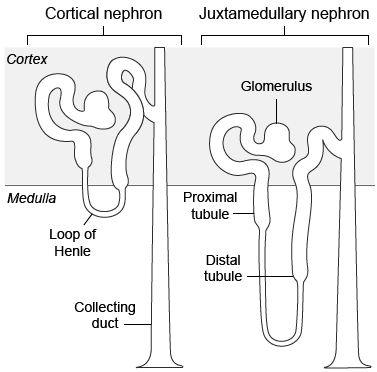 How would the number of cortical nephrons differ from the number of juxtamedullary nephrons in camels and their ancestors? Camels would be expected to have:
A) a lower number of juxtamedullary nephrons and a higher number of cortical nephrons compared to their ancestors.
B) a higher number of juxtamedullary nephrons and a lower number of cortical nephrons compared to their ancestors.
C) a similar number of juxtamedullary nephrons and a lower number of cortical nephrons compared to their ancestors.
D) a similar number of juxtamedullary nephrons and a higher number of cortical nephrons compared to their ancestors.
Correct Answer:

Verified
Correct Answer:
Verified
Q103: Passage<br>Obesity is a condition that affects over
Q104: Passage<br>Within the Actinopterygii (bony fish) lineage, marine
Q105: Passage<br>Lipopolysaccharides (LPS) found in gram-negative bacterial cells
Q106: Passage<br>Renal reabsorption of glucose is facilitated by
Q107: Which step(s) of the viral life cycle
Q109: Passage<br>The heart is a muscular organ comprising
Q110: Stenosis is the abnormal narrowing of a
Q111: Passage<br>Hematological anomalies have been observed in patients
Q112: Passage<br>Viruses are known as obligate intracellular parasites
Q113: Researchers analyzing gene expression in connective tissue