Multiple Choice
Passage
Obesity is a condition that affects over 30% of adults in the United States and is associated with comorbidities such as type 2 diabetes mellitus, heart disease, and cancer. For individuals with clinically severe obesity, defined as having a body mass index above 40 kg/m2, lifestyle interventions may produce insufficient weight reduction. Weight loss surgery, such as Roux-en-Y gastric bypass (RYGB) , has proved to be the most effective clinical intervention for facilitating massive and immediate weight loss in clinically obese patients.In RYGB, the stomach is first divided into a small gastric pouch and a distal gastric remnant, which remains attached to the duodenum. Next, the jejunum is transected and its lower section is connected to the newly created gastric pouch to form the alimentary limb. This connection is typically created with surgical staples. The formation of the alimentary limb allows ingested food to bypass the region composed of the distal gastric remnant, the duodenum, and the upper jejunum; collectively termed the biliopancreatic limb. Finally, the lumen of the upper jejunum is reconnected to the lumen of the lower jejunum to allow enzymes and compounds to flow freely from the biliopancreatic limb into the alimentary limb.
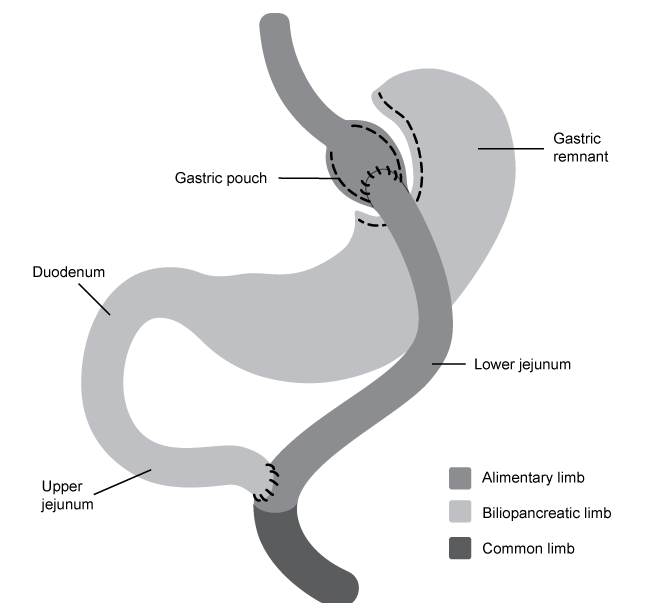 Figure 1 RYGB surgically divides the digestive tract into the alimentary limb and the biliopancreatic limb, which then merge into the common limb.RYGB facilitates weight loss by reducing the functional volume of the stomach and altering intestinal anatomy to induce nutrient malabsorption. However, the procedure is associated with several complications, such as steatorrhea, or fatty stools, due to disruption of lipid digestion. Animal studies also suggest that RYGB promotes the growth of weight loss-inducing gut bacteria. Researchers have found that transplanting gut microbiota of obese postoperative RYGB mice into nonoperated, obese mice lacking gut flora may reproduce the therapeutic effects of RYGB in transplant-recipient mice.
Adapted from Bächler T, Le roux CW, Bueter M. How do patients' clinical phenotype and the physiological mechanisms of the operations impact the choice of bariatric procedure?. Clin Exp Gastroenterol. 2016;9:181-9.
-All of the following are secreted by cells in the alimentary limb of RYGB patients EXCEPT:
A) pepsinogen.
B) trypsinogen.
C) gastrin.
D) mucus.
Correct Answer:

Verified
Correct Answer:
Verified
Q98: Passage<br>The fruit fly Drosophila melanogaster is frequently
Q99: Passage<br>Parathyroid hormone (PTH) is an important regulator
Q100: Passage<br>Osteoarthritis (OA) is a disorder marked by
Q101: Which of the following cell-cell junctions would
Q102: Passage<br>Proteins known as cancer/testis antigens (CTAs) are
Q104: Passage<br>Within the Actinopterygii (bony fish) lineage, marine
Q105: Passage<br>Lipopolysaccharides (LPS) found in gram-negative bacterial cells
Q106: Passage<br>Renal reabsorption of glucose is facilitated by
Q107: Which step(s) of the viral life cycle
Q108: Camels inhabit water-deficient environments and exhibit an