Multiple Choice
A gene regulating tail length in bobtail cats has a genetic variation at a single locus, where organisms can have an allele that produces long tails (L) or an allele that produces short tails (l) . A male cat homozygous for short tail length (ll) was mated with a female cat homozygous for long tail length (LL) . The tail lengths of the parents and offspring were recorded below. 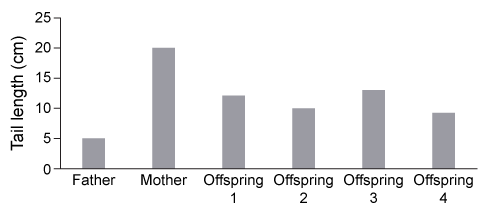 A scientist concludes that the alleles regulating tail length in these cats exhibit incomplete dominance. Do the data support this conclusion?
A) No, because all offspring have longer tails than the father's.
B) No, because all offspring inherited both types of alleles for tail length.
C) Yes, because the tail lengths of some offspring are longer than the tail lengths of other offspring.
D) Yes, because the offspring have tail lengths longer than the father's but shorter than the mother's.
Correct Answer:

Verified
Correct Answer:
Verified
Q57: Passage<br>The nicotinic acetylcholine receptor (nAChR) is a
Q58: Passage<br>Neurulation refers to the early formation of
Q59: The sequence below represents a mature mRNA
Q60: The diagram below shows the results of
Q61: Passage<br>In 1906, the Nobel Prize in Physiology
Q63: Passage<br>A 6-day-old, genotypically normal (46,XX) female patient
Q64: Passage<br>Beta-thalassemia is a blood disorder caused by
Q65: Passage<br>Adeno-associated virus 2 (AAV2) is a nonpathogenic,
Q66: Passage<br>Mitochondria are thought to have been independent
Q67: Passage<br>Skin grafting is a procedure in which