Multiple Choice
Passage
The nicotinic acetylcholine receptor (nAChR) is a protein embedded in the muscle fiber membrane that facilitates cell-to-cell communication across the neuromuscular junction. When acetylcholine (ACh) binds nAChR, electrical depolarization within skeletal muscle fibers is induced and ultimately gives rise to contractile activity. The nAChR is composed of five protein subunits symmetrically organized around a central ion pore. Previous studies demonstrated that these subunits may serve as epitopes (antibody binding sites) in autoimmune disease. By reversibly binding nAChR subunits, anti-nAChr antibodies may temporarily block the attachment site for ACh, resulting in muscle weakness.Researchers harvested muscle samples from mice to investigate the effects of anti-nAChR antibodies on muscle tension, the pulling force transmitted by muscles during contraction.Experiment 1First, skeletal muscle samples (tibialis anterior) of adult male mice were surgically harvested (n = 30) , washed, and stripped of connective tissues. Next, the isolated muscle samples were placed in a 150-mL oxygen-infused, electrolyte-rich bath containing glucose and Ca2+ ions that were able to enter the muscle fibers and enable maximal contractile force. One end of the submerged muscle was anchored in place while the other was attached to an apparatus that measures muscle tension and modifies muscle length. Using electrodes, action potentials were elicited in the harvested muscle tissue to evaluate contractile function (Figure 1) .
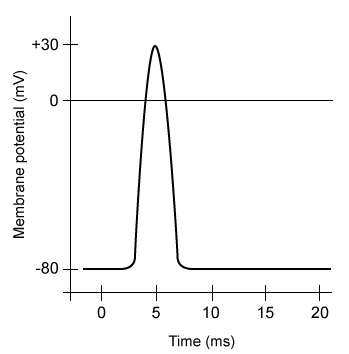 Figure 1 Action potential elicited from a harvested skeletal muscle sampleExperiment 2The researchers divided the 30 muscle samples into three groups of 10. Resting muscle tension was measured, and the electrolyte-rich baths of each group were further infused with a 7.5-mL solution containing mouse-specific anti-nAChR antibodies, ACh, or a mixture of both (Table 1) . Post-infusion (peak) muscle tension was measured for 30 minutes, with results displayed in Figure 2.Table 1 Solutions Infused into the Electrolyte-Rich Bath
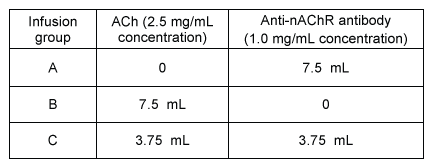
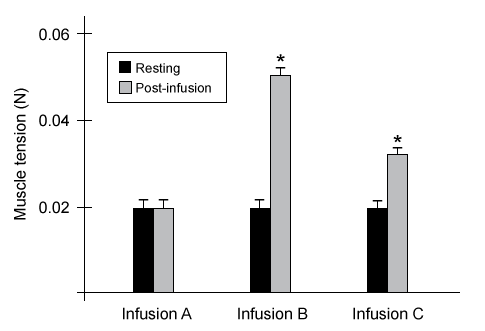 Figure 2 Pre-infusion resting muscle tension and post-infusion peak muscle tension in harvested muscle samples (Note: * indicates p < 0.05.)
-A mutant mouse is found to exhibit normal musculoskeletal function following the administration of anti-nAChR antibodies. Compared to a wild-type mouse, this mutant mouse is most likely to show which of the following changes at the neuromuscular junction?
A) Decreased ACh degradation within the synapse
B) Reduced expression of nAChR by skeletal muscle fibers
C) Decreased reuptake of ACh degradation byproducts into the presynaptic neuron
D) Reduced release of ACh from the presynaptic vesicles
Correct Answer:

Verified
Correct Answer:
Verified
Q52: Passage<br>In the central nervous system, myelin produced
Q53: Passage<br>Renal reabsorption of glucose is facilitated by
Q54: Passage<br>Bone remodeling is the continuous, microscopic process
Q55: Passage<br>Renal reabsorption of glucose is facilitated by
Q56: Passage<br>Spinal muscular atrophy (SMA) is an autosomal
Q58: Passage<br>Neurulation refers to the early formation of
Q59: The sequence below represents a mature mRNA
Q60: The diagram below shows the results of
Q61: Passage<br>In 1906, the Nobel Prize in Physiology
Q62: A gene regulating tail length in bobtail