Multiple Choice
Passage
Bone remodeling is the continuous, microscopic process by which bone tissue throughout the body is resorbed and re-deposited. Proper regulation of bone remodeling is necessary to maintain bone strength and prevent the onset of conditions of fragile bone such as osteoporosis. Patients with such conditions have increased fracture risk and generally exhibit decreased activity of osteoblasts (bone-depositing cells) , leading to reduced bone density and weakening of the bone matrix. However, some cases can occur due to overactive osteoclasts (multinucleated cells that mediate bone resorption) . Osteoclasts resorb bone by secreting proteolytic enzymes and acids into the adjacent extracellular space. These enzymes degrade the organic matrix of bone, and the acid causes the dissolution and release of the mineral components of bone, such as calcium, potassium, and magnesium. Generally, less than 1% of adult bone is occupied by active osteoclasts.Osteoclast differentiation and activation is thought to be related to the RANK/RANKL signaling pathway. RANKL, expressed as a membrane-bound or secreted protein, serves as the ligand for RANK, a transmembrane receptor. In bone tissue, RANK is expressed by precursors of mature osteoclasts, also known as osteoclast progenitor cells (OPCs) . RANKL is expressed by osteoblasts adjacent to OPCs, and the binding of RANKL to RANK in these neighboring cells causes downstream effects through recruitment of TRAF6, an intracellular protein. TRAF6 activates multiple downstream signaling cascades, but only four of these directly mediate the development of mature osteoclasts from OPCs. In one of the four pathways, the transcription factor NF-kB is activated, which leads to increased expression of the proto-oncogene c-Fos. Subsequently, c-Fos interacts with another transcription factor known as NFATc to promote the expression of genes related to osteoclast-specific development and function in OPCs (Figure 1) .
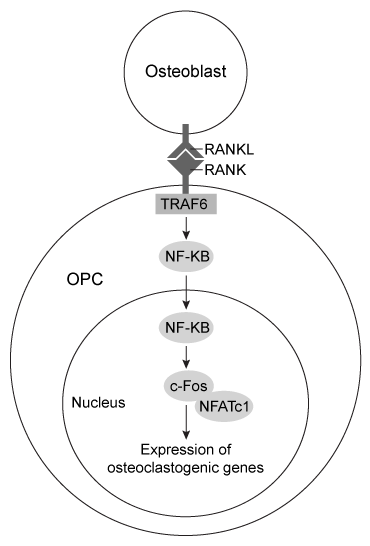 Figure 1 RANK/RANKL signaling induces differentiation of OPCs into osteoclasts
-Cathepsin K is a proteolytic enzyme secreted by osteoclasts. In a clinical trial, patients with osteoporosis due to increased RANK-RANKL signaling are divided into an untreated group (saline placebo administered) and a treated group (cathepsin K inhibitor administered) . Given the information in the passage, bone density after the trial will most likely be:
A) increased in the untreated group compared to the treated group.
B) decreased in the untreated group compared to the treated group.
C) nearly the same in both groups.
D) nearly the same in both groups initially, but then would increase in the untreated group compared to the treated group.
Correct Answer:

Verified
Correct Answer:
Verified
Q49: Researchers are studying the last two phases
Q50: Passage<br>The fruit fly Drosophila melanogaster is frequently
Q51: The North American flying squirrel and the
Q52: Passage<br>In the central nervous system, myelin produced
Q53: Passage<br>Renal reabsorption of glucose is facilitated by
Q55: Passage<br>Renal reabsorption of glucose is facilitated by
Q56: Passage<br>Spinal muscular atrophy (SMA) is an autosomal
Q57: Passage<br>The nicotinic acetylcholine receptor (nAChR) is a
Q58: Passage<br>Neurulation refers to the early formation of
Q59: The sequence below represents a mature mRNA