Multiple Choice
Passage
Bone remodeling is the continuous, microscopic process by which bone tissue throughout the body is resorbed and re-deposited. Proper regulation of bone remodeling is necessary to maintain bone strength and prevent the onset of conditions of fragile bone such as osteoporosis. Patients with such conditions have increased fracture risk and generally exhibit decreased activity of osteoblasts (bone-depositing cells) , leading to reduced bone density and weakening of the bone matrix. However, some cases can occur due to overactive osteoclasts (multinucleated cells that mediate bone resorption) . Osteoclasts resorb bone by secreting proteolytic enzymes and acids into the adjacent extracellular space. These enzymes degrade the organic matrix of bone, and the acid causes the dissolution and release of the mineral components of bone, such as calcium, potassium, and magnesium. Generally, less than 1% of adult bone is occupied by active osteoclasts.Osteoclast differentiation and activation is thought to be related to the RANK/RANKL signaling pathway. RANKL, expressed as a membrane-bound or secreted protein, serves as the ligand for RANK, a transmembrane receptor. In bone tissue, RANK is expressed by precursors of mature osteoclasts, also known as osteoclast progenitor cells (OPCs) . RANKL is expressed by osteoblasts adjacent to OPCs, and the binding of RANKL to RANK in these neighboring cells causes downstream effects through recruitment of TRAF6, an intracellular protein. TRAF6 activates multiple downstream signaling cascades, but only four of these directly mediate the development of mature osteoclasts from OPCs. In one of the four pathways, the transcription factor NF-kB is activated, which leads to increased expression of the proto-oncogene c-Fos. Subsequently, c-Fos interacts with another transcription factor known as NFATc to promote the expression of genes related to osteoclast-specific development and function in OPCs (Figure 1) .
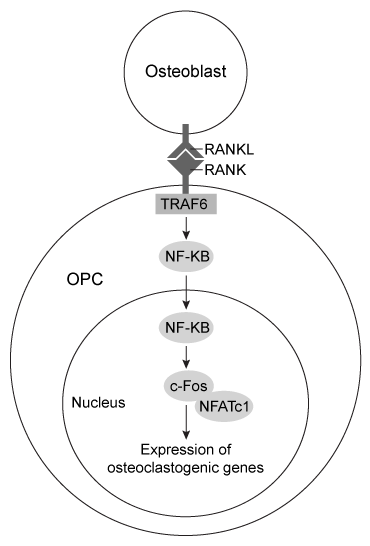 Figure 1 RANK/RANKL signaling induces differentiation of OPCs into osteoclasts
-A student isolates the cellular components of OPCs in wild-type (WT) mice and in mutant (MT) mice exhibiting a single base substitution that causes reduced osteoclast activity. Western blot analysis is then performed to test for NF-kB and c-Fos expression in the cytoplasm and nucleus of OPCs isolated from these mice. The results of this analysis are shown below.  Based on the passage, which statement best explains these results?
A) MT mice have a mutation that disables the ability of NF-kB to localize to the nucleus.
B) MT mice have a mutation that prevents c-Fos from interacting with NF-kB.
C) MT mice have a mutation in the DNA binding region of NF-kB.
D) MT mice have a mutation that prevents the transcription of c-Fos in OPCs.
Correct Answer:

Verified
Correct Answer:
Verified
Q21: Passage<br>Lipopolysaccharides (LPS) found in gram-negative bacterial cells
Q22: Passage<br>Abnormal blood lipid levels play a significant
Q23: Passage<br>Obesity is a condition that affects over
Q24: Which of the following nucleic acid complexes
Q25: Passage<br>Obesity is a condition that affects over
Q27: Passage<br>Quantitative fluorescence recovery after photobleaching (FRAP) is
Q28: Passage<br>A 6-day-old, genotypically normal (46,XX) female patient
Q29: Cirrhosis of the liver is characterized by
Q30: Passage<br>Domestic pigs have been used as valuable
Q31: Passage<br>Alzheimer disease (AD) is a progressive condition