Multiple Choice
Passage
Obesity is a condition that affects over 30% of adults in the United States and is associated with comorbidities such as type 2 diabetes mellitus, heart disease, and cancer. For individuals with clinically severe obesity, defined as having a body mass index above 40 kg/m2, lifestyle interventions may produce insufficient weight reduction. Weight loss surgery, such as Roux-en-Y gastric bypass (RYGB) , has proved to be the most effective clinical intervention for facilitating massive and immediate weight loss in clinically obese patients.In RYGB, the stomach is first divided into a small gastric pouch and a distal gastric remnant, which remains attached to the duodenum. Next, the jejunum is transected and its lower section is connected to the newly created gastric pouch to form the alimentary limb. This connection is typically created with surgical staples. The formation of the alimentary limb allows ingested food to bypass the region composed of the distal gastric remnant, the duodenum, and the upper jejunum; collectively termed the biliopancreatic limb. Finally, the lumen of the upper jejunum is reconnected to the lumen of the lower jejunum to allow enzymes and compounds to flow freely from the biliopancreatic limb into the alimentary limb.
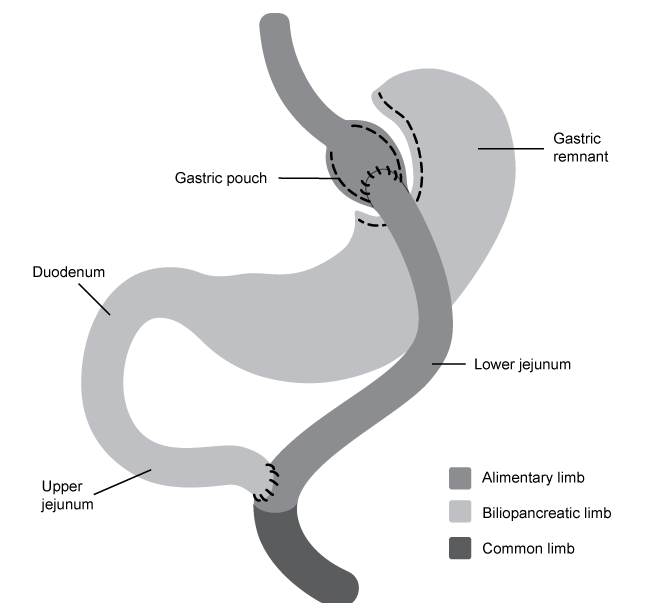 Figure 1 RYGB surgically divides the digestive tract into the alimentary limb and the biliopancreatic limb, which then merge into the common limb.RYGB facilitates weight loss by reducing the functional volume of the stomach and altering intestinal anatomy to induce nutrient malabsorption. However, the procedure is associated with several complications, such as steatorrhea, or fatty stools, due to disruption of lipid digestion. Animal studies also suggest that RYGB promotes the growth of weight loss-inducing gut bacteria. Researchers have found that transplanting gut microbiota of obese postoperative RYGB mice into nonoperated, obese mice lacking gut flora may reproduce the therapeutic effects of RYGB in transplant-recipient mice.
Adapted from Bächler T, Le roux CW, Bueter M. How do patients' clinical phenotype and the physiological mechanisms of the operations impact the choice of bariatric procedure?. Clin Exp Gastroenterol. 2016;9:181-9.
-Obese mice underwent either RYGB or sham (placebo) surgery, and two weeks post-surgery, their fecal matter was transplanted into the guts of nonoperated, obese mice lacking gut flora (germ-free recipients) . The body weight of RYGB flora recipients (RYGB-R) and sham surgery flora recipients (SHAM-R) was measured for 3 weeks postcolonization. Which graphic shows the expected result of this experiment?
A) 
B) 
C) 
D) 
Correct Answer:

Verified
Correct Answer:
Verified
Q20: Passage<br>Alzheimer disease (AD) is a progressive condition
Q21: Passage<br>Lipopolysaccharides (LPS) found in gram-negative bacterial cells
Q22: Passage<br>Abnormal blood lipid levels play a significant
Q23: Passage<br>Obesity is a condition that affects over
Q24: Which of the following nucleic acid complexes
Q26: Passage<br>Bone remodeling is the continuous, microscopic process
Q27: Passage<br>Quantitative fluorescence recovery after photobleaching (FRAP) is
Q28: Passage<br>A 6-day-old, genotypically normal (46,XX) female patient
Q29: Cirrhosis of the liver is characterized by
Q30: Passage<br>Domestic pigs have been used as valuable