Passage Lipopolysaccharides (LPS) Found in Gram-Negative Bacterial Cells Can Elicit a a Lethal
Multiple Choice
Passage
Lipopolysaccharides (LPS) found in gram-negative bacterial cells can elicit a lethal degree of adjuvanticity, or immune activation, in LPS-responsive host organisms. In mice, responses may be modulated by abnormalities in the toll-like receptor (TLR) encoded by the Tlr4 gene closely linked to coat color on Chromosome 4. To investigate the effect of a particular Tlr4 mutation on LPS response, three experiments were performed following a cross between fully responsive He-N mice [tlr4(+) /tlr4(+) ] and He-J mice homozygous for the mutation [tlr4(d) /tlr4(d) ].Experiment 1Researchers isolated spleen cells for analysis of protein expression and LPS response. In cells isolated from F1 mice, both wild-type and mutant TLRs were distinguishable by protein electrophoresis. Following this first analysis, spleen cells from each cohort were exposed to 2 × 10⁵ SRC, an antigen formed by sheep erythrocytes. Cultures were then incubated in the presence or absence of Ph-LPS, with LPS extracted from Escherichia coli K345 cells using a phenol-water mixture. Titers of anti-SRC antibody were recorded on incubation day 5, with the results shown in Table 1.Table 1 Mean anti-SRC titers with standard error
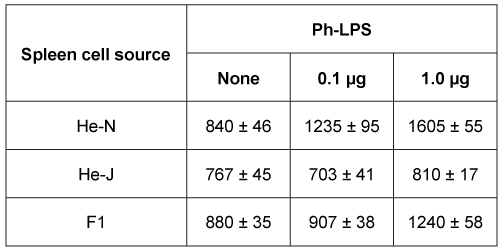 Experiment 2Serum samples were assayed for interferon production 2 hours post LPS injection. Interferon was quantified using a plaque reduction assay on mouse cells challenged with vesicular stomatitis virus.
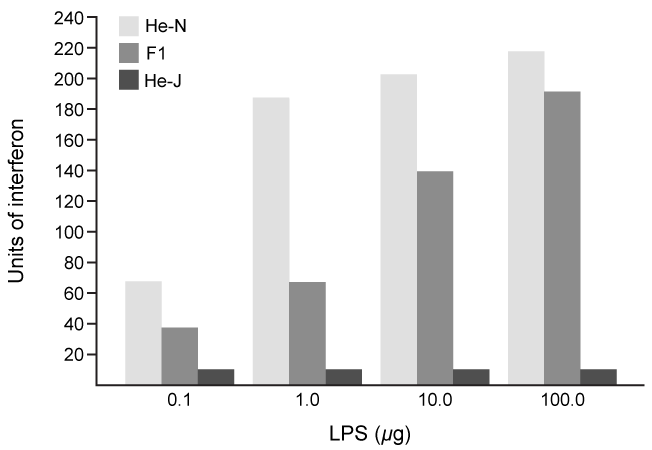 Figure 1 Average serum interferon levels in mice cohortsExperiment 3Mice were injected with varying doses of Ph-LPS and monitored for 4 days. The lethal dose (LD50) was defined as the minimum dose causing death in 50% of injected mice. Compared to He-N mice, results reflected a 10-fold increase in LD50 for F1 mice and a 100-fold increase in LD50 for He-J mice.
-The experiments allowed researchers to determine the effect of genotype variation on all of the following EXCEPT:
A) in vitro versus in vivo studies.
B) innate versus adaptive immune responses.
C) responses modulated by LPS exposure.
D) qualitative and quantitative phenotypic traits.
Correct Answer:

Verified
Correct Answer:
Verified
Q16: Passage<br>A 6-day-old, genotypically normal (46,XX) female patient
Q17: Assume a single-celled organism was discovered in
Q18: A patient is found to have reduced
Q19: A student adds 5 bacterial cells to
Q20: Passage<br>Alzheimer disease (AD) is a progressive condition
Q22: Passage<br>Abnormal blood lipid levels play a significant
Q23: Passage<br>Obesity is a condition that affects over
Q24: Which of the following nucleic acid complexes
Q25: Passage<br>Obesity is a condition that affects over
Q26: Passage<br>Bone remodeling is the continuous, microscopic process